来源核查日期 / Source-review date: 2026-11-11
本章从甘蔗叶片中的细胞位置出发,解释二氧化碳进入、初始固定、细胞间运输、脱羧和再次羧化怎样构成空间分工。 重点不是把一张横切面图当作全部机制,而是把“看见的结构”“检测到的分子”和“测得的通量”放回各自的证据层级。
This chapter starts with cell position in a sugarcane leaf and explains the spatial organization of carbon entry, initial fixation, intercellular transport, decarboxylation and subsequent carboxylation. A transverse section is not the whole mechanism: visible structure, detected molecules and measured flux are kept at their respective evidentiary levels.
本章采用8篇原始研究及1项关联勘误登记,复用2幅有来源和许可的真实显微图版。 论文、图版、细胞器和独立植株分别计数。 正文已形成研究初稿;部分原始方法、原始数据和勘误全文仍待补核,不代表全书或独立专家终审。
Eight primary papers and one linked correction notice inform this draft, with two reused, traceable and licensed microscopy plates. Papers, plates, organelles and independent plants are counted separately. Some methods, raw data and the correction text remain unresolved; this is not whole-book or independent expert approval.
01 研究对象与核心问题
Objects and key questions
1.1 本章研究的是“细胞网络”,不是叶片外形
A cellular network, not merely the outline of a leaf
C4空间分工包含两个相互约束的问题:碳怎样在邻接细胞之间周转,以及浓缩后的CO2怎样在再次固定前得到有效保留。 因而需要联合观察叶肉细胞、含叶绿体的维管束鞘、叶脉及细胞间通路。 仅凭叶宽、绿色深浅或气孔数量,不能判断这些环节是否协调。 [R01,R02,R04]
C4 spatial organization poses two coupled questions: how carbon cycles between neighbouring cells, and how concentrated CO2 is retained long enough for refixation. Mesophyll, chlorenchymatous bundle sheath, veins and intercellular connections must therefore be considered together. Leaf width, greenness or stomatal counts alone cannot establish their coordination. [R01,R02,R04]
1.2 建立四组取样坐标
Establish four sets of sampling coordinates
建议每份样本同时登记:植株与永久叶片编号;当前叶位及叶龄;距叶基或叶尖的距离和是否含中脉;叶脉等级、细胞类型与细胞器。 处理历史和取样时刻另列。 这样才能区分同一叶片的发育梯度、不同叶片年龄差异和环境处理效应。 只写“取功能叶”不足以复现实验。 [R03]
Record plant and permanent leaf IDs, current rank and age, distance from the base or tip and midrib inclusion, and vein class, cell type and organelle. Keep treatment history and harvest time as additional fields. These distinguish longitudinal development, age differences among leaves and environmental responses. “A functional leaf was sampled” is not a reproducible location. [R03]
1.3 三种证据不能互相冒名
Three kinds of evidence are not interchangeable
显微结构回答细胞在哪里以及彼此怎样接触;定位实验回答某种蛋白或转录本在哪里检出;通量实验回答某段时间内有多少物质经过一条路径。 三者互补。 表达量上升不能直接充当运输速度,胞间连丝坑场变大也不能直接充当CO2泄漏率下降。 [R01,R03,R06]
Microscopy locates cells and their contacts; localization assays identify where a protein or transcript is detected; flux measurements quantify material moving through a pathway over time. These are complementary. Higher expression is not a transport velocity, and a larger plasmodesmatal pit field is not evidence of lower CO2 leakage. [R01,R03,R06]
1.4 从机制问题走向可检验比较
Turn a mechanism into a testable comparison
一个可检验的问题应指定材料、叶段、处理和结果,例如:“相同叶龄与供水条件下,界面几何差异能否解释独立测得的碳同化差异? ”解释前应列出替代原因:气孔限制、酶活变化、叶氮分配或样品收缩。 本文后面的试验建议是研究设计,不是已经获得的结论。
A testable question specifies material, position, treatment and outcome: for example, whether interface geometry explains independently measured assimilation at matched age and water status. List alternatives first, including stomatal limitation, enzyme activity, nitrogen allocation and preparation shrinkage. The experimental proposals below are designs, not completed findings.
02 结构基础与过程机制
Structural basis and process mechanisms
2.1 从表皮到叶脉的识别顺序
An identification sequence from epidermis to vein
读横切面时先确定向轴面与背轴面,再区分表皮、气孔所在区域、叶肉、维管束鞘和输导组织。 叶缘、中脉与脉间区不能相互替代。 叶片弯折会改变图上方向,因此“图上方”不自动等于向轴面。 组织身份应由样本方向和连续切片支持,而不是由图像颜色独立决定。 [R02,R07]
Start a transverse section by establishing adaxial and abaxial surfaces, then identify epidermis, stomatal regions, mesophyll, sheaths and conducting tissue. Margin, midrib and interveinal regions are not interchangeable. Folding can reverse apparent orientation, so the top of an image is not automatically adaxial. Identity requires orientation metadata and, where necessary, serial sections rather than colour alone. [R02,R07]
2.2 Kranz维管束鞘与厚壁鞘
Kranz bundle sheath versus mestome sheath
成熟甘蔗叶的不同等级叶脉,其鞘层配置并不完全相同。 L62-96的超微结构研究描述了大型叶脉外层含叶绿体的鞘与内层厚壁鞘。 由此,不能把切面中的所有环状细胞统一标作“C4固定CO2的细胞”。 细胞功能解释必须先建立组织同源性。 [R02]
Sheath arrangement differs among vein classes in mature cane leaves. Ultrastructural work on L62-96 describes an outer chlorenchymatous sheath and an inner mestome sheath around major veins. Consequently, not every ring of cells in a section can be labelled the C4 CO2-fixing compartment. Functional interpretation starts with homologous tissue identification. [R02]
2.3 泡状细胞不是维管束鞘细胞
Bulliform cells are not bundle-sheath cells
本章复用显微图中的BC是bulliform cell,即泡状细胞或运动细胞;它位于表皮相关区域。 维管束鞘则围绕叶脉,本文用BS表示。 两个缩写都容易在二次配图时误写。 泡状细胞大小变化可作为形态记录,但不等于测得了叶卷曲力、气孔导度或C4碳浓缩能力。 [R07]
BC in the reused plate means bulliform cell, an epidermis-associated cell; BS in this chapter denotes the sheath around a vein. These abbreviations are easily confused when figures are relabelled. A size change in bulliform cells is a morphological observation, not a measurement of rolling force, stomatal conductance or C4 concentrating capacity. [R07]
表025-01 细胞识别与不可替代的证据 / Cell identity and non-interchangeable evidence
对象 / Object | 定位依据 / Identification | 不能据此直接推断 / Not established |
|---|---|---|
叶肉 M / Mesophyll | 脉间组织与叶绿体 / Interveinal cells and chloroplasts | 所有C4酶都仅在此处 / Exclusive location of every C4 enzyme |
维管束鞘 BS / Bundle sheath | 叶脉外围含叶绿体细胞 / Chlorenchymatous cells around veins | 活体CO2浓度 / In-vivo CO2 concentration |
厚壁鞘 / Mestome sheath | 与叶脉等级、内外位置相联系 / Vein class and inner position | 与光合BS完全等同 / Identity with photosynthetic BS |
泡状细胞 BC / Bulliform cell | 原图术语与表皮位置 / Source terminology and epidermal position | C4脱羧位置 / C4 decarboxylation site |
2.4 以NADP-ME为主的工作模型
A working map centred on NADP-ME
在常用甘蔗C4工作模型中,进入叶肉的CO2先转入可供PEPC利用的碳酸氢根库。 PEPC以HCO3−为无机碳底物形成草酰乙酸;在典型NADP-ME路线中,苹果酸形成、向维管束鞘转移和脱羧把碳送往Rubisco附近。 必须把最初的四碳产物形成与Calvin循环的三碳产物形成区分开。 [R04,R05,R06]
In the standard cane C4 working model, CO2 entering mesophyll feeds the bicarbonate pool used by PEPC. PEPC uses HCO3− to produce oxaloacetate. In the typical NADP-ME route, malate formation, transfer to the bundle sheath and decarboxylation deliver carbon near Rubisco. Initial four-carbon product formation must be distinguished from three-carbon product formation in the Calvin cycle. [R04,R05,R06]
表025-02 主路线的空间记录框架 / Spatial record for the dominant route
过程 / Process | 工作模型中的位置 / Working location | 记录限制 / Recording limit |
|---|---|---|
初始羧化 / Initial carboxylation | 叶肉细胞质;PEPC / Mesophyll cytosol; PEPC | 不是Rubisco的同一步 / Not the Rubisco reaction |
苹果酸形成 / Malate formation | 叶肉叶绿体;NADP-MDH / Mesophyll chloroplast; NADP-MDH | 需区分酶名与同工型 / Distinguish enzyme class and isoform |
脱羧 / Decarboxylation | BS叶绿体;NADP-ME / BS chloroplast; NADP-ME | PEPCK等并行活动另列 / Record parallel routes separately |
再次羧化 / Refixation | BS叶绿体;Rubisco / BS chloroplast; Rubisco | 浓缩效果不能只由位置推出 / Location alone does not quantify enrichment |
受体再生 / Acceptor regeneration | 丙酮酸回程;叶肉PPDK / Pyruvate return; mesophyll PPDK | 回程与能量供给均需闭合 / Return and energy supply must balance |
上表是机制组织框架,不是本章对每一个甘蔗品种进行免疫定位所得的完整图谱。 特定同工型的细胞与亚细胞位置应有独立定位证据;基因名称相似或全叶转录量较高,均不足以补上这一环节。
This table organizes the mechanism; it is not a complete localization atlas experimentally established here for every cultivar. Cell and subcellular placement of a particular isoform needs independent evidence. A similar gene name or abundant whole-leaf transcript cannot supply that evidence.
2.5 两个细胞之间,还有多个膜界面
Several membrane interfaces remain between two cells
“苹果酸从M到BS”压缩了多个步骤:叶绿体包膜交换、细胞质中的移动、相邻细胞间的连接,以及目的叶绿体的摄取。 胞间连丝连接细胞的共质体,但不能替代跨叶绿体包膜的运输。 因此,PD数多与膜转运容量足够是两项不同假设,任何一项不足都可能限制整条回路。 [R01,R04,R08]
“Malate moves from M to BS” compresses envelope exchange, cytosolic movement, symplastic connection and uptake into the receiving chloroplast. Plasmodesmata connect cellular symplasts but do not replace chloroplast-envelope transport. Numerous PD and sufficient membrane transport capacity are therefore separate hypotheses; either could constrain the circuit. [R01,R04,R08]
2.6 两类叶绿体共同参与能量与碳代谢
Both chloroplast classes participate in energy and carbon metabolism
叶肉和维管束鞘都含叶绿体。 不能把前者叫“只做光反应”,把后者叫“只做暗反应”,更不能因为Calvin循环名称中常出现“暗反应”就认为它只在夜间进行。 空间分工意味着过程配置不同,而不是一类细胞完全不需要光合能量。 具体电子传递与能量分配留待第026、027章深化。 [R01,R04]
Both mesophyll and bundle-sheath cells contain chloroplasts. They must not be labelled exclusively light-reaction and dark-reaction cells, nor should the conventional term “dark reactions” imply a night-only Calvin cycle. Spatial specialization means different allocations of processes, not the absence of photosynthetic energy requirements from one cell class. Chapters 026–027 develop electron transfer and energy allocation. [R01,R04]
2.7 胞间连丝坑场:几何量与功能量分开
Pit fields: separate geometry from function
坑场是细胞壁上胞间连丝集中分布的区域。 测得坑场覆盖面积后,还缺少单根连接数、有效孔径、开放状态和浓度梯度,才可能估算某种物质的运输。 把“覆盖面积增加一倍”写成“运输速度增加一倍”并不成立。 不同接口还应分开:M–BS、M–M与BS–BS不是同一种路径。 [R01,R08]
A pit field is a wall region containing clustered plasmodesmata. Coverage area alone leaves individual connection number, effective aperture, opening state and concentration gradient unspecified. Doubling coverage therefore does not establish doubled transport. M–BS, M–M and BS–BS interfaces must also be recorded separately because they represent different paths. [R01,R08]
2.8 保留CO2与交换代谢物的双重要求
Retaining CO2 while exchanging metabolites
有效的碳浓缩需要足够快的代谢物交换,又需要限制CO2从浓缩部位逸散。 这并不要求所有边界都具有相同性质:细胞壁、木栓质层、胞间连丝与膜可对不同分子形成不同通路。 因而“结构更封闭”或“连接更多”都不是单向的优良性状。 需要测定收益、泄漏、能量代价与环境依赖性。 [R02,R04]
A concentrating mechanism needs rapid metabolite exchange while restricting escape of concentrated CO2. Different boundaries need not behave alike: walls, suberin, PD and membranes provide different paths for different molecules. Neither a more sealed structure nor more connections is an unconditionally superior trait. Benefit, leakage, energy cost and environmental dependence need testing. [R02,R04]
物理上可以写出条件性的扩散关系J=gΔc,但这只是说明通量取决于传导率和驱动力。 显微图可约束部分几何参数,不能自动给出整体g。 本章不依据切片厚度填造活体泄漏率,也不设定全球通用的“最佳鞘壁厚度”。
A conditional diffusion relation J=gΔc expresses dependence on conductance and driving force. Microscopy can constrain geometry but cannot automatically identify the aggregate g. No in-vivo leakage rates are invented from section thickness, and no globally optimal sheath-wall thickness is assigned.
03 生育阶段与环境响应
Developmental stages and environmental responses
3.1 同一片叶并不是均一试样
One leaf is not a homogeneous sample
沿叶基到叶尖的组织发育、展开程度和暴露历史可能不同。 SP80-3280的叶段研究提供了直接实例:不同位置的光合和分子指标并不一致。 因此,比较品种时如果一个取叶基、另一个取中段,观察差异不能被归因于品种本身。 应固定取样坐标,同时保留永久叶片身份。 [R03]
Development, expansion and exposure history can differ along a blade. Segment comparisons in SP80-3280 directly demonstrate positional variation in physiological and molecular traits. Sampling the base in one genotype and the middle in another cannot identify a genotype effect. Standardize coordinates while retaining permanent leaf identity. [R03]
3.2 新叶形成与成熟叶变化分开
Separate new-leaf development from mature-leaf change
处理前已成熟的叶片与处理期间新形成的叶片不能合并成同一个响应组。 前者主要用于追踪既有结构的变化,后者包含发育过程受到处理影响的结果。 建议设置转移前标记叶与新出现叶两类,并区分短时生理测量和破坏性解剖取样;同一叶片不能被重复破坏取样后仍称完整重复观测。
Leaves mature before a treatment and leaves formed during it should not be pooled as one response group. The former track changes in existing structures; the latter include altered development. Mark pre-existing leaves and new cohorts separately, and distinguish repeated physiological measurements from destructive anatomy. A destructively sampled organ is not an intact repeatedly measured leaf.
3.3 干旱改变结构,也改变代谢运行状态
Drought changes structure and metabolic operating state
水分不足时,解剖、气孔、代谢与生长可能同时改变。 KKU显微研究提供形态资料;另一项两品种酶学研究支持PEPCK参与增强的解释。 这两类证据不应拼成未经测量的因果链:“某细胞变大→PEPCK通量增加→耐旱增产”。 连接这些环节需要在匹配材料与处理下同步检验。 [R04,R07]
Water deficit can alter anatomy, stomata, metabolism and growth together. KKU micrographs provide morphology, while a separate two-cultivar enzyme study supports increased PEPCK involvement. Combining them does not establish an unmeasured causal chain from cell enlargement through PEPCK flux to drought yield. The links require matched material and treatment. [R04,R07]
3.4 可塑性、损伤与遗传适应
Plasticity, injury and genetic adaptation
处理后的结构差异可能来自可塑性,也可能包含细胞脱水、发育迟缓或制样差异。 一次盆栽处理不能证明长期遗传适应。 建议报告复水后是否恢复、同一材料跨批次是否重现、是否伴随功能损失,以及处理是否改变了实际叶龄。 把形态指标和功能指标分别保存,有利于保留这些竞争解释。
Post-treatment anatomy can reflect plasticity, dehydration, delayed development or preparation differences. One pot treatment cannot establish long-term genetic adaptation. Record recovery, repeatability across batches, possible functional injury and changes in actual developmental age. Keeping structural and functional variables separate preserves these alternative explanations.
04 品种及生态区差异
Genotypic and ecological differences
4.1 材料身份比笼统的“甘蔗”更重要
Material identity matters more than a generic cane label
商业杂交品种、野生甘蔗属材料及近缘C4作物不应混成同一证据层级。 CPCL02-0926的三维形态、L62-96的成熟叶超微结构和S. spontaneum的调控结果,各有自己的材料范围。 它们可以共同提出机制问题,却不能相互替代其独立品种验证。 [R01,R02,R05]
Commercial hybrids, wild Saccharum and related C4 crops should not be merged into one evidentiary class. Three-dimensional anatomy in CPCL02-0926, mature-leaf ultrastructure in L62-96 and regulatory findings in S. spontaneum each have their own scope. Together they generate hypotheses, but none substitutes for independent testing in the others. [R01,R02,R05]
4.2 生态区比较应控制发育与制样
Control development and preparation across environments
跨地区的叶厚、细胞面积或叶绿体大小比较,至少应对齐叶位、纵向叶段、供水状态、光照历史、采样时刻和固定方法。 低海拔温室与雨养田间差异不是单一“生态区效应”。 如果材料和方法同时变化,应将记录归为描述性对照,而不是直接计算环境响应倍数。
Cross-region comparisons of thickness, cell area or chloroplast size should align leaf rank, blade position, water status, light history, sampling time and fixation. A lowland greenhouse–rainfed field contrast is not a single regional effect. When material and method change together, retain a descriptive comparison rather than calculating an environmental response factor.
4.3 不以单个结构指标排名
Do not rank genotypes by one anatomical trait
更密的叶脉、更多叶绿体或更大的BS并不自动意味着更高糖产量。 结构改变还影响组织建造、资源分配和运输距离;产量要经过群体受光、季节碳收支与分配环节。 建议把解剖性状作为待检验解释变量,与独立的气体交换、同位素或实收数据相连,而非先赋予“优良”标签。
Denser venation, more chloroplasts or a larger BS does not automatically mean greater sugar yield. Structural changes also affect construction, allocation and transport distance, while yield depends on canopy interception, seasonal balance and partitioning. Treat anatomy as a candidate explanatory variable linked to independent physiology or harvest measurements, rather than assigning a superior label in advance.
表025-03 跨材料比较的最低对齐项 / Minimum matching criteria
类别 / Category | 必须记录 / Required record | 不允许的替代 / Invalid substitute |
|---|---|---|
身份 / Identity | 品种、来源、繁殖方式 / Genotype, provenance, propagation | 以物种名称代替品种 / Species name instead of genotype |
位置 / Position | 叶位、距基部距离、叶脉级别 / Rank, basal distance, vein class | 用中脉代表全部叶片 / Midrib for the whole blade |
环境 / Environment | 供水、光温、取样时刻 / Water, light, temperature, time | 仅写国家或季节 / Country or season alone |
方法 / Method | 固定、分辨率、分割与尺度 / Fixation, resolution, segmentation, scale | 把2D面积直接并入3D体积 / Pooling 2D area with 3D volume |
05 原始试验与相反证据
Original experiments and conflicting evidence
5.1 三维形态:数值及取样层级
Three-dimensional anatomy: values and nesting
Lee等2023年的甘蔗样本来自3株植株。 用于叶绿体统计的BS和M细胞器分别为19和242个;下表转录原论文表1的均值与标准误,并保留细胞器层级。 该表显示所取样BS叶绿体的平均体积更大,但不是对全部品种的普遍比例,也不是增产或因果试验。 [R01]
Lee et al. sampled three cane plants. Their chloroplast analysis included 19 BS and 242 M organelles. The following published means and standard errors retain that organelle-level scope. A larger BS mean in this sample is neither a universal genotype ratio nor a causal yield result. [R01]
表025-04 发表的甘蔗叶绿体汇总值 / Published cane chloroplast summaries
细胞器 / Organelle | 体积 / Volume (μm³) | 表面积 / Surface (μm²) | 层级 / Level |
|---|---|---|---|
BS叶绿体 / BS chloroplast | 86.2 ± 6.5 | 146.1 ± 11.4 | 19个,来自3株 |
M叶绿体 / M chloroplast | 30.3 ± 0.8 | 73.3 ± 2.0 | 242个,来自3株 |
“±”为原文SE。 本章核验了原PDF的表1与图1,但没有取得逐植株原始数据,不能重新计算以植株为单位的置信区间。 若以器官或细胞器为单位比较,应明确它们嵌套于哪一株;增加同株图像数量不会增加独立植株数。 [R01]
The uncertainty is the source-reported SE. Table 1 and Figure 1 were checked visually, but plant-level raw records were not acquired, so plant-based confidence intervals cannot be recalculated. Organ and organelle comparisons must preserve their plant nesting; more images of one plant do not create more independent plants. [R01]
5.2 同位素证据与细胞定位证据相互补充
Tracer evidence complements localization evidence
Hatch与Slack的短时标记研究发现,约1秒暴露后,超过93%的固定放射性进入苹果酸、天冬氨酸和草酰乙酸。 这是理解早期四碳产物的重要路径证据,但不是叶肉与BS的直接定位实验。 不能把这一比例改写为“叶片93%的碳都储存在C4酸中”。 本章只核读原始摘要。 [R06]
In the short-pulse study of Hatch and Slack, over 93% of fixed radioactivity appeared in malate, aspartate and oxaloacetate after approximately one second. This supports early four-carbon products but does not directly localize M and BS reactions. It must not be restated as 93% of all leaf carbon being stored in C4 acids. Access here was limited to the primary abstract. [R06]
5.3 主路线不排除并行机制
A dominant route does not exclude parallel mechanisms
将甘蔗归入NADP-ME类型,是对主要脱羧配置的概括,不表示所有环境下其他脱羧活动为零。 水分限制研究中的酶活与表达变化支持PEPCK额外参与;S. spontaneum的调控研究则关注NADP-ME相关网络。 这不是简单的互相否定,因为材料、处理和观测终点不同。 实际通量比例仍需专门测量。 [R04,R05]
Classifying cane as NADP-ME describes its dominant configuration; it does not imply zero alternative decarboxylation under every condition. Water-deficit assays support additional PEPCK involvement, whereas work in S. spontaneum addresses a NADP-ME regulatory network. Different material, conditions and endpoints mean these are not simple contradictions. Actual pathway fractions still require dedicated measurements. [R04,R05]
5.4 研究矩阵与勘误控制
Study matrix and correction control
下表按论文而不是“验证次数”列出证据。 R08为非甘蔗方法比较,PubMed关联了2018年勘误;由于勘误全文尚未取得,本章不采用其原始摘要中的密度、倍数和推算通量。 保留文献与勘误关联比忽略更新后直接摘录数字更稳妥。 [R08,C01]
The matrix counts papers, not independent confirmations. R08 is a non-cane methods comparison with a linked 2018 correction in PubMed. Because the correction text remains unavailable, its original density, fold-change and inferred-flux numbers are withheld. The record preserves the relationship rather than silently reusing potentially affected numbers. [R08,C01]
表025-05 原始研究的用途与边界 / Primary evidence and boundaries
来源 / Source | 本章用途 / Use | 关键边界 / Boundary |
|---|---|---|
R01 Lee 2023 | 3D叶绿体与接口 / 3-D chloroplasts and interfaces | 3株;不是田间功能验证 / Three plants; not field validation |
R02 Robinson-Beers 1991 | 叶脉与鞘层 / Veins and sheaths | 摘要;n未知 / Abstract; n unknown |
R03 Mattiello 2015 | 叶长发育梯度 / Longitudinal gradient | 混合细胞样本 / Mixed-cell segments |
R04 Cacefo 2019 | 脱羧可塑性 / Decarboxylation plasticity | 酶活不是直接通量 / Activity is not direct flux |
R05 Hua 2024 | 野生材料调控 / Wild-material regulation | 摘要;不代表全部品种 / Abstract; not all cultivars |
R06 Hatch & Slack 1966 | 标记路径 / Tracer pathway | 摘要;不定位细胞 / Abstract; no cell localization |
R07 Taratima 2021 | 真实显微图 / Authentic microscopy | 同研究双图;标签差异 / Two plates, one study; label conflicts |
R08 Danila 2016 + C01 | 接口定量方法 / Interface methods | 无甘蔗;勘误待核 / No cane; correction pending |
06 观测指标与测量方法
Variables and measurement methods
6.1 从植株到像素的层级设计
A hierarchy from plant to pixel
建议使用plant_id→leaf_id→segment_id→section_id→cell_id→organelle_id的关联结构。 处理通常施加在植株、小区或设施层级;统计独立性应按随机化层级确定,而非按图像数量确定。 每层都保留纳入、剔除及缺失原因。 若不知道不同照片是否来自同一株,应标未知而不是默认独立。
Use linked plant, leaf, segment, section, cell and organelle IDs. Treatments are generally assigned at plant, plot or facility level; independence follows randomization, not image count. Preserve inclusion, exclusion and missingness reasons at every level. Unknown specimen relationships should remain unknown rather than being assumed independent.
6.2 固定、切片与分割的质量控制
Quality control of preparation, sectioning and segmentation
固定时间、脱水与包埋流程、切片厚度、刀痕、斜切角度和像素标定都会影响几何记录。 连续堆栈应检查配准、缺层与边缘截断;排除不完整细胞器时要说明筛选可能改变大小分布。 建议随机抽取盲法复核图像,保存分割掩膜与人工修改日志;只有展示最漂亮的切片会产生选择偏差。
Fixation, dehydration, embedding, section thickness, cutting artifacts, obliquity and calibration affect geometry. Serial stacks need checks for registration, missing slices and truncated objects. Excluding incomplete organelles can alter the size distribution and must be reported. Random blinded rechecks, retained masks and edit logs are preferable to selecting only attractive sections.
6.3 定位、活性和通量的配对验证
Pair localization, activity and flux validation
分离叶肉或BS用于酶学、蛋白或RNA分析时,建议设置两方向污染标志和回收率,并记录分离时间。 免疫定位需要阴性对照及抗体特异性检查。 通量问题则需时间序列、示踪或经过独立验证的模型。 全叶酶活上升可能来自组织比例、提取效率或代谢状态变化,不能单独判定某细胞的贡献。
For isolated M or BS assays, use contamination markers in both directions, recovery measures and isolation timing. Immunolocalization requires negative controls and specificity checks. Flux questions need time series, tracers or independently validated models. A rise in whole-leaf activity can reflect tissue composition, extraction or operating state; it cannot alone assign a cell-type contribution.
表025-06 核心数据库字段 / Core database fields
字段 / Field | 内容 / Content | 核查规则 / Check |
|---|---|---|
material + hierarchy | 材料及嵌套ID / Material and nested IDs | 不把器官数当株数 / No organ-to-plant substitution |
position + stage | 叶位、叶段、发育 / Rank, position, development | 保留长度单位与坐标原点 / Preserve units and origin |
geometry + method | 面积/体积、仪器、标定 / Geometry, instrument, calibration | μm²与μm³不得混列 / Keep area and volume distinct |
estimate + uncertainty | 均值、误差类型、n层级 / Estimate, error type, n level | SE不自动写为SD / Do not relabel SE as SD |
provenance + rights | DOI、图号、哈希、许可 / DOI, figure, hash, license | 未知值null并注明原因 / Nulls require reasons |
6.4 演算一:比例尺校准与二维限制
Example 1: scale calibration and two-dimensional limits
以下全部为教学假设,不是对本章原图进行的数字化测量。 假定100 μm标尺在工作图上长250像素,则标定为0.4 μm/像素;某线段为125像素时长度为50 μm。 图像若被横向和纵向不同倍率拉伸,必须分别标定;不能用一个方向的标尺直接计算另一个方向的尺寸。
The following is illustrative, not digitization of either original plate. If a 100 μm bar spans 250 pixels, calibration is 0.4 μm per pixel and a 125-pixel line is 50 μm. If horizontal and vertical resizing differ, each axis needs its own calibration; a one-axis bar cannot calibrate the other axis.
s = 100 / 250 = 0.4 μm pixel⁻¹ ; l = 125 × 0.4 = 50 μm
在各向同性缩放下,面积按s²换算;三维体积必须同时具有z方向步长。 可用分层分割写作V≈ΣAᵢΔzᵢ,但需要完整对象、连续层与配准。 仅一个横切面的细胞面积,无论多清晰,都不能无假设地转换为该细胞体积。
With isotropic scaling, area uses s². Volume additionally requires the z-step. A segmented stack can estimate V≈ΣAᵢΔzᵢ, provided the object is complete, registered and continuously sampled. A single profile, however sharp, cannot yield cell volume without further assumptions.
6.5 演算二:体积比例的分母
Example 2: denominators of volume fractions
假定两个细胞体积为100与900 μm³,叶绿体总体积分别为50与180 μm³。 逐细胞比例的平均为35%,合并体积比为23%。 前者给每个细胞相同权重,后者给每单位细胞体积相同权重;二者回答不同问题。 真实研究还应先按独立植株汇总,避免某株切片更多而占据过大权重。
Suppose two cells have volumes of 100 and 900 μm³ and chloroplast totals of 50 and 180 μm³. The mean cell fraction is 35%, whereas the pooled-volume fraction is 23%. The first weights cells equally and the second weights cell volume. They answer different questions. Real analyses should also preserve plant-level weighting so that a heavily sampled plant does not dominate.
Mean fraction = (50/100 + 180/900)/2 = 0.35
Pooled fraction = (50 + 180)/(100 + 900) = 0.23
6.6 演算三:解剖不能独立确定通量
Example 3: anatomy alone does not identify flux
假设某界面稳态线性传导率g为10⁻⁴ m/s,浓度差Δc为0.2 mol/m³,则J为2×10⁻⁵ mol m⁻² s⁻¹,即20 μmol m⁻² s⁻¹。 这只是量纲一致的演算,不是甘蔗实测值。 若有效面积、化学形态或边界条件改变,g必须重新解释;不能从图中坑场面积直接填入g。
Assume a steady linear conductance g of 10⁻⁴ m/s and concentration difference Δc of 0.2 mol/m³. Then J is 2×10⁻⁵ mol m⁻² s⁻¹, or 20 μmol m⁻² s⁻¹. This is dimensional arithmetic, not a cane observation. Changes in effective area, chemical form or boundary conditions require reinterpreting g; pit-field area cannot simply be inserted as conductance.
J = gΔc = 10⁻⁴ × 0.2 = 2 × 10⁻⁵ mol m⁻² s⁻¹
07 真实图像与机制图解
Authentic images and mechanism interpretation
7.1 显微图版一:叶缘、表皮和气孔
Microscopy plate 1: margins, epidermis and stomata
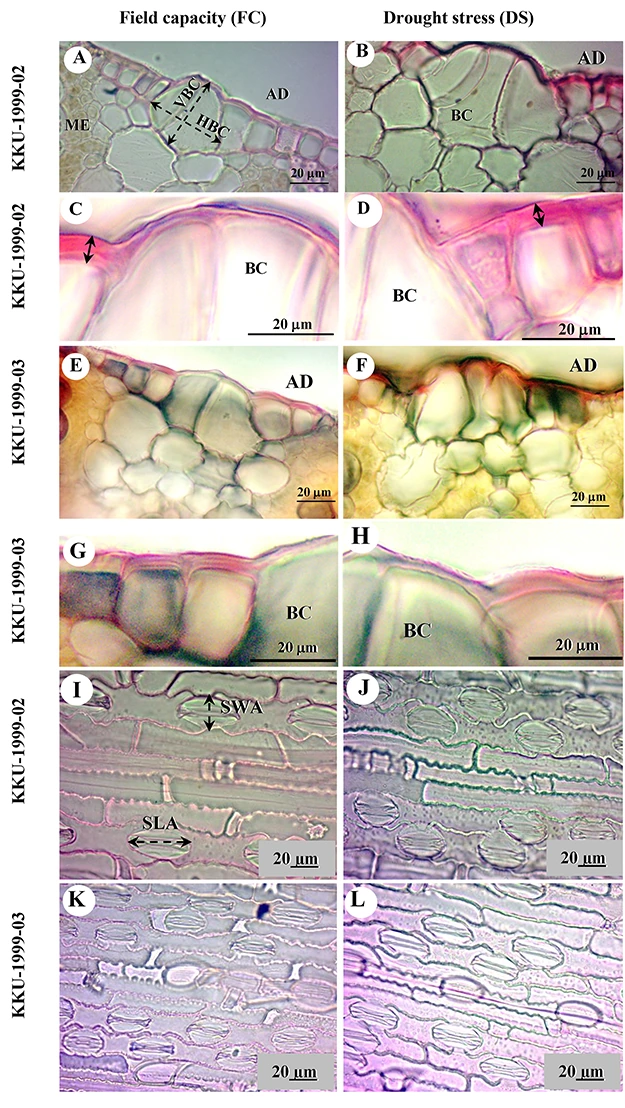
网页预览经过缩放或格式转换,未裁切;原比例尺与标签保留。 / Web preview resized or re-encoded without cropping; original scales and labels retained.
图025-01 / Figure 025-01. Taratima et al. (2021), original Figure 1, panels A–L. CC BY 4.0. 原像素未修改 / Original pixels unchanged. [R07]
两个甘蔗品种在田间持水量对照(FC)与干旱(DS)条件下的原始显微图;每个面板保留20 μm比例尺。 BC表示泡状细胞,ME表示叶肉。 该图能展示组织外观,不能据此确定PEPC、Rubisco的位置或测算C4通量。 [R07]
Original micrographs of two cane cultivars under field-capacity control (FC) and drought (DS), retaining 20 μm bars. BC means bulliform cell and ME means mesophyll. The plate shows morphology, not PEPC/Rubisco localization or C4 flux. [R07]
7.2 显微图版二:叶片及中脉横切面
Microscopy plate 2: blade and midrib sections
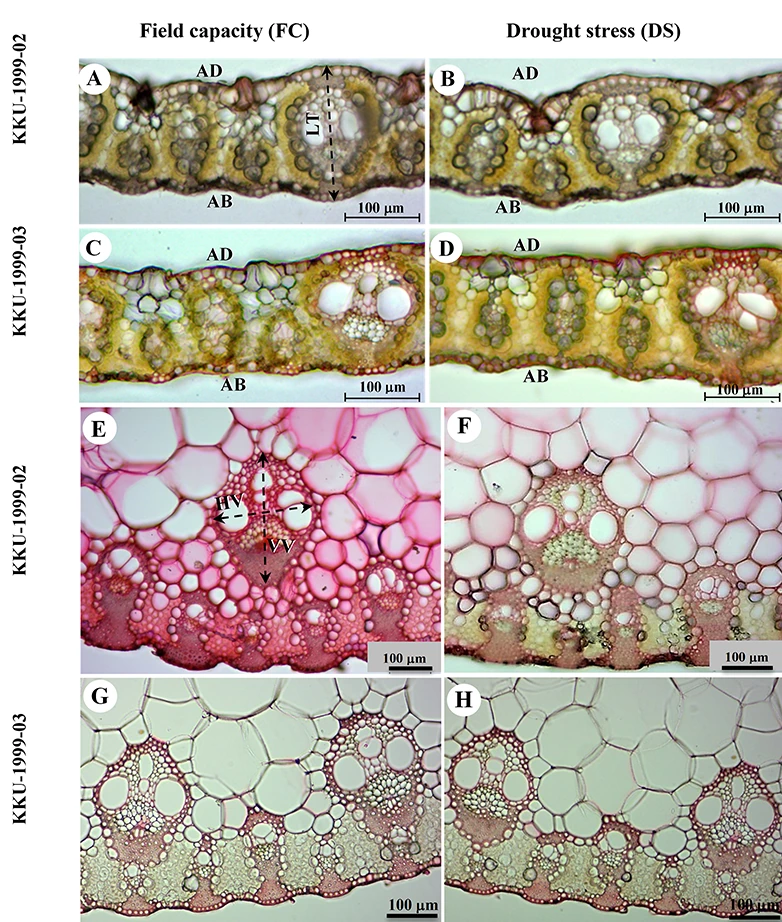
网页预览经过缩放或格式转换,未裁切;原比例尺与标签保留。 / Web preview resized or re-encoded without cropping; original scales and labels retained.
图025-02 / Figure 025-02. Taratima et al. (2021), original Figure 2, panels A–H. CC BY 4.0. 原像素未修改 / Original pixels unchanged. [R07]
A—D为叶片横切面,E—H为中脉区域;原100 μm比例尺保留。 图中LT是叶片厚度,VV与HV是大型维管束的垂直和水平尺寸标签,并不是BS细胞大小。 图版与图025-01属于同一研究,不新增独立试验。 [R07]
A–D show blade sections and E–H the midrib region, with original 100 μm bars. LT labels leaf thickness; VV and HV label vertical and horizontal dimensions of a major vascular bundle, not BS cell size. This plate and Figure 025-01 are the same study, not separate experimental confirmations. [R07]
7.3 双语标签释义与原始冲突
Bilingual label key and source conflicts
表025-07 原图标签的读取 / Reading source labels
标签 / Label | 中文释义 | English and boundary |
|---|---|---|
FC / DS | 田间持水量对照 / 干旱处理 | Field capacity control / drought stress |
BC | 泡状细胞;不是BS | Bulliform cell; not bundle sheath |
ME | 叶肉 | Mesophyll |
AD / AB | 向轴面 / 背轴面 | Adaxial / abaxial surface |
VBC / HBC | 泡状细胞垂直 / 水平尺寸 | Vertical / horizontal bulliform-cell dimension |
LT | 叶片厚度 | Leaf thickness |
VV / HV | 大型维管束垂直 / 水平尺寸 | Vertical / horizontal major-bundle dimension |
SWA / SLA | 原图气孔宽 / 长标签;叶面释义有冲突 | Source stomatal width / length labels; surface wording conflicts |
保留两项原始差异:图1的I—L说明与SWA/SLA所指叶面不一致;图2正文说明出现E—G,而完整图版包含E—H。 本文保留全部面板,不自行改写原标签。 准确采图日期、显微镜操作者和单个面板对应的独立植株仍未知;许可依据为既有档案中的论文专属CC BY 4.0声明。 [R07]
Two source discrepancies are retained: the surface described for Figure1 I–L conflicts with SWA/SLA terminology, and the Figure2 description says E–G although the complete plate contains E–H. All panels and original labels remain unchanged. Exact capture dates, microscope operator and independent plant identity for each panel remain unknown. The archived article-specific notice establishes CC BY 4.0 reuse. [R07]
7.4 三维重建与照片要分别归类
Classify 3-D reconstructions separately from photographs
R01图1既包含原始电镜切面,也包含分割后生成的三维对象;后者是基于显微数据的重建,不是直接摄影,也不是AI生成。 该图已在线视觉核验,但原文件未成功保存,因此本章只登记线索,不把它计入新取得图像。 两个已保存图版均核对SHA-256,并保留原文件与中文、英文图注。 [R01,R07]
R01 Figure1 combines electron micrographs and segmented 3-D objects. The latter are microscopy-derived reconstructions, not direct photographs or AI images. The figure was checked remotely, but an original file was not saved; it remains a lead rather than a newly acquired image. Both saved plates have verified SHA-256 hashes, original bytes and bilingual captions. [R01,R07]
08 适用边界与研究缺口
Applicability and research gaps
8.1 一张结构图能支持到哪一步
How far an anatomical image can support a claim
原图可以支持可见组织的存在、空间位置和在已校准条件下的几何测量。 它不能独立证明酶的专一分布、某条通路的运行比例、叶片净碳收益或实收糖产量。 即使另有全叶酶活,也需检验细胞定位与组织比例是否匹配。 完整机制解释应使结构、分子、过程和结果能够逐级追溯,而不是用共同相关性代替连接证据。
An original image supports visible tissues, spatial positions and calibrated geometry. It cannot alone establish enzyme specificity, pathway fractions, net carbon benefit or harvested sugar. Even whole-leaf activity requires checks on cell localization and tissue composition. A mechanism should trace structure, molecules, processes and outcomes stepwise rather than replacing the links with shared correlations.
8.2 优先补足的验证链
Priority validation chain
建议在同一批材料中建立“解剖—定位—气体交换—示踪”的配对样本,并将发育位置和水分状态作为分层条件。 优先检验改变接口结构时,其他过程是否同时改变;有遗传或处理干预时,同时保留背景对照与恢复观察。 样本量根据独立植株变异和目标效应设计,不能照搬本章文献中的细胞器数量。
Build matched anatomy, localization, gas-exchange and tracer samples within the same material, stratifying by development and water status. Test whether other processes change when interface structure changes, and retain background controls and recovery measurements for interventions. Sample size should follow independent plant variance and the targeted effect, not an organelle count copied from a paper.
8.3 全书承接与尚未解决的问题
Connections and unresolved questions
第026、027章承接能量转换与供需,第028—030章深化羧化与脱羧,第031章研究CO2扩散。 仍需取得R02、R05、R06和R08完整方法、R08勘误全文、逐细胞/逐植株数据,以及与酶定位或通量同步的影像。 本章没有新下载原始观测数据,未宣称8篇论文是8次独立验证,也未建立全球统一结构阈值。
Chapters026–027 address energy conversion and demand; 028–030 develop carboxylation and decarboxylation; 031 examines CO2 diffusion. Outstanding needs are full methods for R02/R05/R06/R08, the R08 correction, cell- and plant-level data, and imagery paired with localization or flux. No new raw observations were downloaded, eight papers are not called eight independent confirmations, and no universal anatomical threshold is proposed.
本章结论:甘蔗C4优势依赖空间配置与过程运行的协调,而不是一个细胞大小或一张漂亮的切片。 高质量的结构研究必须让取样层级、位置、分母、尺度与来源透明,并把尚未测到的功能明确留空。
Chapter conclusion: C4 function in cane depends on coordinated spatial organization and operating processes, not one cell dimension or an attractive section. Strong anatomical records make sampling hierarchy, position, denominators, scale and provenance explicit, while leaving unmeasured functions unresolved.
双语术语表 / Bilingual glossary
表025-08 核心术语(上)/ Core terms (part 1)
中文 | English | 缩写 / Abbreviation |
|---|---|---|
叶肉 | Mesophyll | M |
含叶绿体维管束鞘 | Chlorenchymatous bundle sheath | BS |
花环结构 | Kranz anatomy | Kranz |
厚壁鞘 | Mestome sheath | |
泡状细胞 | Bulliform cell | BC in R07 |
向轴面 | Adaxial surface | AD |
背轴面 | Abaxial surface | AB |
中脉 | Midrib | |
脉间区 | Interveinal region | |
叶脉等级 | Vein class | |
细胞间隙 | Intercellular airspace | IAS |
叶绿体 | Chloroplast | |
叶绿体包膜 | Chloroplast envelope | |
细胞质基质 | Cytosol | |
木栓质层 | Suberin lamella | |
胞间连丝 | Plasmodesma / plasmodesmata | PD |
胞间连丝坑场 | Plasmodesmatal pit field | PF |
共质体 | Symplast | |
初始羧化 | Initial carboxylation | |
脱羧 | Decarboxylation |
双语术语表(续)/ Glossary continued
表025-09 核心术语(下)/ Core terms (part 2)
中文 | English | 缩写 / Abbreviation |
|---|---|---|
碳浓缩机制 | CO2-concentrating mechanism | CCM |
磷酸烯醇式丙酮酸羧化酶 | Phosphoenolpyruvate carboxylase | PEPC |
磷酸烯醇式丙酮酸 | Phosphoenolpyruvate | PEP |
丙酮酸磷酸双激酶 | Pyruvate phosphate dikinase | PPDK |
NADP依赖苹果酸酶 | NADP-dependent malic enzyme | NADP-ME |
NADP依赖苹果酸脱氢酶 | NADP-dependent malate dehydrogenase | NADP-MDH |
磷酸烯醇式丙酮酸羧激酶 | Phosphoenolpyruvate carboxykinase | PEPCK |
核酮糖二磷酸羧化/加氧酶 | Ribulose-1,5-bisphosphate carboxylase/oxygenase | Rubisco |
草酰乙酸 | Oxaloacetate | OAA |
苹果酸 | Malate | |
天冬氨酸 | Aspartate | |
串行块面扫描电镜 | Serial block-face scanning electron microscopy | SBF-SEM |
共聚焦激光扫描显微镜 | Confocal laser scanning microscopy | LSM |
透射电子显微镜 | Transmission electron microscopy | TEM |
分割掩膜 | Segmentation mask | |
三维重建 | Three-dimensional reconstruction | 3-D |
生物学重复 | Biological replicate | |
嵌套子样本 | Nested subsample | |
标准误 | Standard error | SE |
同位素示踪 | Isotopic tracing |
原始来源与访问边界 / Sources and access limits
[R01] Lee MS; Boyd RA; Boateng KA; Ort DR (2023). Exploring 3D leaf anatomical traits for C4 photosynthesis: chloroplast and plasmodesmata pit field size in maize and sugarcane. DOI: 10.1111/nph.18956
https://nph.onlinelibrary.wiley.com/doi/full/10.1111/nph.18956
全文网页及原PDF表1/图1核验;未保存原始堆栈。
Full HTML and original PDF Table1/Figure1 checked; raw stack not acquired.
[R02] Robinson-Beers K; Evert RF (1991). Ultrastructure of and plasmodesmatal frequency in mature leaves of sugarcane. DOI: 10.1007/BF00195330
https://pubmed.ncbi.nlm.nih.gov/24194146/
仅原始摘要;独立重复及定量表待核。
Primary abstract only; independent replication and quantitative tables pending.
[R03] Mattiello L; Riaño-Pachón DM; Martins MCM; da Cruz LP; Bassi D; Marchiori PER; Ribeiro RV; Labate MTV; Labate CA; Menossi M (2015). Physiological and transcriptional analyses of developmental stages along sugarcane leaf. DOI: 10.1186/s12870-015-0694-z
https://link.springer.com/article/10.1186/s12870-015-0694-z
全文网页;相关SRA/TSA登记号仅据文章记录,未下载。
Full HTML; article-reported SRA/TSA accessions recorded, not downloaded.
[R04] Cacefo V; Ribas AF; Zilliani RR; Neris DM; Domingues DS; Moro AL; Vieira LGE (2019). Decarboxylation mechanisms of C4 photosynthesis in Saccharum spp.: increased PEPCK activity under water-limiting conditions. DOI: 10.1186/s12870-019-1745-7
https://link.springer.com/article/10.1186/s12870-019-1745-7
全文网页;品种编号RB92579/RB92578差异保留。
Full HTML; RB92579/RB92578 cultivar-code discrepancy retained.
图像许可 / Image permission
图025-01、025-02均来自R07,采用CC BY 4.0。 来源、作者、图号和许可随图保留;原件未裁切或重绘。 其图像许可不意味着其他文献的图像也可自由复制。
Figures025-01 and025-02 are from R07 under CC BY4.0. Attribution, source figure and license are retained, with no cropping or redrawing of the original files. Their license does not imply permission to reproduce imagery from other papers.
https://creativecommons.org/licenses/by/4.0/
原始来源(续)/ Sources continued
[R05] Hua X et al. (2024). Regulatory network of the late-recruited primary decarboxylase C4NADP-ME in sugarcane. DOI: 10.1093/plphys/kiae455
https://pubmed.ncbi.nlm.nih.gov/39276364/
摘要及索引层级;不提供全方法核查或通用定位结论。
Abstract and index level; not a full-method audit or universal localization claim.
[R06] Hatch MD; Slack CR (1966). Photosynthesis by sugar-cane leaves. A new carboxylation reaction and the pathway of sugar formation. DOI: 10.1042/bj1010103
https://pubmed.ncbi.nlm.nih.gov/5971771/
原始索引摘要;全文方法未核读。
Primary indexed abstract; full methods not inspected.
[R07] Taratima W; Ritmaha T; Jongrungklang N; Maneerattanarungroj P (2021). Leaf Anatomical Adaptation Under Early Drought Stress of Sugarcane Cultivars – KKU-1999-02 and KKU-1999-03. DOI: 10.5586/aa.7419
全文网页及两幅既有原始图版;图注冲突已登记。
Full HTML and two archived original plates; caption conflicts recorded.
[R08] Danila FR; Quick WP; White RG; Furbank RT; von Caemmerer S (2016). The Metabolite Pathway between Bundle Sheath and Mesophyll: Quantification of Plasmodesmata in Leaves of C3 and C4 Monocots. DOI: 10.1105/tpc.16.00155
https://pubmed.ncbi.nlm.nih.gov/27288224/
摘要与图注层级,另有勘误;未采用定量结果。
Abstract and captions, with a correction; quantitative results withheld.
[C01] CORRECTION (2018). Plant Cell 30(2):513. DOI: 10.1105/tpc.18.00115. https://pubmed.ncbi.nlm.nih.gov/29436474/
勘误登记已核实,正文获取未成功;不计作新增研究或独立验证。
The correction notice was verified but its text was not obtained; it is not an additional study or independent confirmation. The evidence JSON retains claims, numeric types and locations, image hashes, null reasons and access status.