CHAPTER 006 · Physiological Age, Thermal Time and Development Rate
独立编号 SUG-PHY-V01-C006 | 前章 C005 | 后章 C007 | 证据截止:2026-11-09
本章核心问题:日历年龄与积温在解释甘蔗发育进程时各有哪些适用边界? 本章所有温度阈值均标明来源、研究对象、物候事件及数值性质,不建立“全球统一基温”。
Core question: What are the limits of calendar age and thermal time in explaining sugarcane development? Every temperature threshold below is tied to an identifiable source, biological event and numerical provenance; no universal global base temperature is asserted.
研究速览 / Research orientation
中文概念 / Chinese concept | English convention / Notes |
|---|---|
日历年龄:从预先登记的种植、收获或出苗日起算,单位d | Calendar age: elapsed days from a declared origin (d) |
有效积温:依温度响应函数累积,单位°C·d | Accumulated thermal time: temperature-response integral (°C d) |
叶间积温:新叶达到同一观察事件的热量间隔 | Phyllochron: thermal interval per defined leaf event (°C d leaf⁻¹) |
发育事件:出苗、叶尖、叶舌、分蘖峰值等逐个定义 | Developmental event: define emergence, leaf tip, ligule or tiller peak separately |
证据等级A:原文方法或结果可直接核查 | Grade A: directly inspected original methods/results |
证据等级B/C:摘要支持 / 参数模型及方法推理 | Grade B/C: limited abstract / model-setting or synthesis |
一、研究对象、时钟定义和可检验的问题
I. Research objects, clocks and testable questions
1.1 三种时钟并非同义 / 1.1 Three clocks are not interchangeable
甘蔗的日历年龄是从指定起点到观察日经过的天数;积温年龄是依某个温度响应函数累积的热量指标;生理或发育年龄则指分生组织、叶序、节间和生殖状态所处的实际阶段。 同一株蔗可以在120个日历日达到不同叶数,两块蔗田也可能积累相同度日却有不同的有效分蘖或糖分。 只有事先规定“起点—器官—事件—温度算法—观察频率”,才可把两个生长过程作比较。 [S01,S04,S05]
Calendar age counts elapsed days from an explicitly named origin. Thermal age accumulates a temperature-response function over that interval, whereas physiological or developmental age denotes the observed state of meristems, leaves, internodes and reproductive structures. A crop with 120 elapsed days need not have the same leaf number in two environments; even equal degree-day totals need not imply equal tiller survival or sucrose status. Every comparison must state its origin, organ, event, temperature algorithm and observation interval. [S01,S04,S05]
1.2 甘蔗的多起点问题 / 1.2 The multiple-origin problem in sugarcane
新植蔗可从下种日、蔗芽萌动日、出苗50%日或者标记主茎首叶展开日计时;宿根蔗则常从砍收、再萌芽、出土或选定分蘖建群计时。 这些起点间有不同长度的隐蔽阶段,不能在论文之间静默互换。 单芽发根、出苗和主茎出现并不处在相同组织层级。 对同一试验,建议并列存储种植或收获日期、土壤温度序列和已观察到的第一个可重复物候事件。 [S07,S08,M01]
Plant-cane studies may start clocks at planting, bud activation, 50% emergence or the first expanded leaf on a tagged primary stalk. Ratoon studies may start at harvest, renewed bud growth, crop emergence or the establishment of a selected tiller cohort. The concealed periods between those origins differ and must not be silently exchanged. Bud rooting, shoot emergence and primary-stalk appearance are different tissue-level events. Store planting or harvest date alongside soil temperature and the earliest reproducible observed event. [S07,S08,M01]
1.3 生长速率与发育速率 / 1.3 Growth rate versus development rate
发育速率衡量叶原基分化、叶尖出现、可见叶舌、节的形成或分蘖转换等事件的频度;生长速率衡量叶面积、节间长度、茎质量或器官体积的增量。 一条温度曲线可能加快节形成,却缩短节间并改变糖的组成。 Bonnett等的温度处理实验表明,高温下节间数与单节长度可以反向变化,说明不能使用“节数更多”推断“茎更高或更甜”。 [S06]
Development rate concerns frequencies or timing of primordium initiation, visible leaf tips, exposed ligules, node production and transitions in tillering. Growth rate refers to increments in leaf area, internode length, stalk mass or organ volume. A temperature regime can accelerate node production while shortening internodes and altering sugar composition. Bonnett and colleagues found more but shorter internodes in their warmer treatment; node number is therefore not a surrogate for height or sucrose. [S06]
1.4 本章四个可以证伪的假说 / 1.4 Four falsifiable working hypotheses
可检验假说包括:在无显著水分限制且低于最适温度时,按温度归一的出叶间隔跨季节比按日历日更稳定;叶尖与可见叶舌的积温阈值不同;基温对出苗、分蘖、节间伸长和光合作用不能共用;在热端或复合胁迫下,简单线性度日模型会产生有方向性的预测误差。 每项假说必须以留出的年份或地点检验,而不是在拟合原数据后便宣称机制成立。 [S02,S04,S05,M01]
Testable hypotheses are that temperature-normalized phyllochron is more transferable than elapsed-day phyllochron under non-limiting water and sub-optimal temperatures; leaf-tip and visible-ligule events require distinct thermal sums; emergence, tillering, internode elongation and photosynthesis cannot share one base temperature; and linear degree-day models develop directional errors under supra-optimal heat or combined stress. Fit and prediction must be tested on held-out years or sites rather than declared mechanistic merely because the fitted curves look accurate. [S02,S04,S05,M01]
二、温度驱动的结构与过程
II. Temperature-dependent structures and processes
2.1 叶原基、叶尖、叶舌与节形成 / 2.1 Primordia, leaf tips, ligules and node deposition
甘蔗茎尖分生组织产生叶原基后,叶片需要生长穿越叶鞘并露出叶尖,再经历展开到叶舌可见的阶段。 显微层面的原基产生率、外部可见叶尖数和完全展开叶数是三套不同的测量结果。 田间叶片常以最高可见叶舌为判据,幼叶则可通过露出心叶筒的叶尖计数。 Streck研究同时测量这两套指标,并明确计算各自的叶间积温。 [S05]
After initiation at the shoot apical meristem, a leaf must elongate through enclosing sheaths before its tip becomes visible and later expands enough to expose its ligule. Primordium initiation, visible-tip number and fully expanded leaf number are distinct observational series. The topmost visible ligule provides one field convention; visible tips within the whorl provide another. Streck and coauthors recorded both and estimated separate thermal phyllochrons. [S05]
2.2 叶间积温的数学含义 / 2.2 The mathematical meaning of phyllochron
叶间积温(phyllochron)是连续两个规定叶片事件之间的热量间隔,单位为°C·d·叶⁻¹;其倒数是在给定积温标尺下的出叶率。 若以累计叶数对累计度日作线性回归,斜率是叶·(°C·d)⁻¹,倒数才是叶间积温。 叶尖与叶舌、初期与后期的回归必须分开报告,不能把一个整季平均数当作所有叶位的固定属性。 [S01,S02,S05]
Phyllochron is the thermal interval separating successive observations of a defined leaf event, reported as °C d leaf⁻¹; its inverse is the leaf appearance rate on that scale. A regression of cumulative leaves against accumulated degree-days has slope leaves (°C d)⁻¹, whose reciprocal is phyllochron. Leaf tips and exposed ligules, and early and late leaf ranks, need distinct estimates or an explicit model showing they can be pooled. A whole-season mean is not a universal property of every leaf rank. [S01,S02,S05]
2.3 基温、最适温与上限温不是常数表 / 2.3 Base, optimum and ceiling temperatures are process parameters
用Tᵦ表示某过程外推停止的基温、Tₒ表示该过程热效率较高的最适点或平台、Tᵤ表示高温限值。 它们并不自动等同于细胞真实的死亡温度。 Liu等在同一研究中给Q138出苗、茎出现、节间伸长、叶出现分别拟合出不同的基温;Canesim也为萌发、分蘖和冠层覆盖设置了不同参数。 这样做强调过程专一性,但模型值与实测统计估计仍属不同证据类型。 [S04,M01]
The base temperature Tb marks the extrapolated lower limit of developmental progress for a modeled process; To is an optimum or plateau and Tu a supra-optimal bound. These are not necessarily lethal tissue temperatures. Liu and coauthors estimated distinct lower thresholds for Q138 shoot emergence, stalk appearance, elongation and leaf appearance. The Canesim documentation similarly assigns different cardinal temperatures to germination, tillering and canopy cover. These quantities are process-specific, but fitted experimental thresholds and chosen simulation parameters are different evidence classes. [S04,M01]
2.4 线性度日公式的隐含条件 / 2.4 Assumptions behind linear growing degree-days
最简式日热量为GDDᵢ=max[0,(Tmaxᵢ+Tminᵢ)/2−Tᵦ]×1 d,累计GDD为各日之和。 这个计算只在研究指定的温区近似描述发育速率;高温超最适时,继续线性加热量可能错误。 两个日均温相同的日子,可以由于日间高温时长或夜温不同产生不同的器官反应;土温与气温也不等价。 计算表须明确负值截断、上限截断、逐小时积分以及缺测填补规则。 [S04,M01]
A basic daily equation is GDDᵢ = max[0, ((Tmaxᵢ+Tminᵢ)/2 − Tb)] × 1 day; accumulated GDD is its sum. It approximates a process only over the validated portion of its temperature response. Above optimum, continuing the linear subtraction over-credits heat. Equal daily means can hide very different durations of daytime heat and nighttime cold; root-zone temperature differs from air temperature as well. Computations must document zero truncation, upper clipping, hourly integration and treatment of missing observations. [S04,M01]
算式与算法对照 / Thermal computation
日均温线性有效热量:GDDᵢ = max{0,[(Tmaxᵢ + Tminᵢ)/2 − Tb]} × 1 d;累计热量 ATTₙ = Σᵢ GDDᵢ。 只在温度低于最适范围且算法已验证时使用。 高温段应考虑三基温分段或逐小时温度积分;同一篇论文的作者采用的算法才可用来复现其数值。
Daily linear heat: GDDᵢ = max{0, [(Tmaxᵢ + Tminᵢ)/2 − Tb]} × 1 day; cumulative thermal time ATTₙ = Σᵢ GDDᵢ. Use only within the validated suboptimal response range. Above the optimum, consider cardinal-temperature piecewise functions or hourly integration; use the source paper’s exact formula when reproducing its estimate.
三、物候阶段、日季变化与环境限制
III. Developmental stages, seasons and environmental limitations
3.1 芽的萌动和50%出苗 / 3.1 Bud activation and 50% emergence
蔗芽萌动受种茎生理状态、芽位置、含水量、温度及土壤通气控制。 田间50%出苗被定义为样区出苗株数达到规定比例的日期,而不是一条单芽抽芽的计时记录。 Streck的田间研究按小区每日计数并以50%为出苗日。 若只储存种植后日数而不记录种茎节数和含水条件,就不能区分材料活力差异和环境热量差异。 [S05,S09]
Bud activation is conditional on sett physiological condition, bud position, water, temperature and soil aeration. Field 50% emergence is a plot-level threshold in observed seedlings, not the elapsed time of one isolated bud. Streck et al. counted emerging plants daily per plot and defined emergence at 50%. Without the number of sett nodes and moisture conditions, days-after-planting cannot distinguish propagation vigour from differences in heat availability. [S05,S09]
3.2 分蘖建立、死亡和密度 / 3.2 Tiller establishment, mortality and density
分蘖数量先受芽萌发和光照影响,随后又受竞争、遮阴、缺水、空间和营养调节,通常形成“出现—峰值—死亡—稳定”过程。 分蘖峰值的积温并不能代替最终有效茎数,因后续死亡具有环境依赖性。 Inman-Bamber在特定南非材料上报告宿根后接近500 °Cd出现最大茎密度;这是特定研究的发表汇总,不能作为所有气候区的统一收获或生长节点。 [S01,S07,S08]
Tiller population is first shaped by bud activation and light and subsequently by competition, shading, water, space and nutrients, often following an emergence–peak–mortality–stabilization sequence. Thermal time to peak density cannot replace the final number of millable stalks because later mortality is environmentally contingent. Inman-Bamber reported a stalk-density maximum near 500 °Cd after ratooning in a specified South African dataset; this is a published context-bound result, not a worldwide developmental milestone. [S01,S07,S08]
3.3 伸长和糖积累时钟 / 3.3 Elongation and sucrose-accumulation clocks
节间延伸发生在节点形成之后,组织年龄沿茎轴呈梯度变化;同时蔗糖储存取决于叶片供碳、茎组织库容量、韧皮部运输、水分及代谢转化。 即使累计度日预测了某个叶数,也不等于它预测了蔗糖成熟度。 Saez等在阿根廷多品种研究中将早期源库关系、分蘖死亡阶段和成熟早晚联系起来,但其报道的成熟热量阈值并非一个通用收获标准。 [S06,S07]
Internode extension follows node formation and tissue age forms a gradient along the culm. Sucrose storage depends jointly on leaf carbon supply, stem sink capacity, phloem transport, water status and metabolism. Predicting a leaf count from degree-days does not automatically predict sugar ripeness. Saez and colleagues linked early source–sink relationships, a tiller mortality phase and differences in ripening among Argentine genotypes, but their thermal sums to maximum sucrose cannot serve as a universal harvest rule. [S06,S07]
3.4 光周期、水分和极端温度 / 3.4 Photoperiod, water and temperature extremes
温度是发育的一项驱动而非唯一驱动。 干旱可能降低叶片伸展与气孔导度、改变分蘖死亡,使“每摄氏度日”的出叶效果失去平稳性;阴蔽、营养限制、病虫害和极端低温也可能改变观察事件与真正分生过程的时间差。 光周期与开花调控应在专章研究,不能凭热量把营养生长转折视为同一遗传事件。 热量模型的残差需与降雨、土壤水分、辐射和叶温联合核查。 [S01,S05,S07]
Temperature drives development but is not its sole regulator. Drought may suppress leaf extension and stomatal function, change tiller mortality and invalidate a stationary leaf-per-degree-day assumption; shade, nutrient shortage, disease and temperature extremes can also shift the delay between an internal meristem event and its visible endpoint. Photoperiodic floral regulation needs its own evidence: a thermal threshold alone must not be mistaken for a fixed genetic transition. Examine model residuals against rainfall, soil moisture, radiation and leaf temperature. [S01,S05,S07]
四、品种、蔗作类型与全球生态区
IV. Cultivars, crop classes and eco-regional transfer
4.1 澳大利亚Q117与Q138的直接比较 / 4.1 A controlled comparison of Q117 and Q138
Campbell等将六个月龄Q117和Q138植株置于14、18、22、26°C的控制环境,在该温区内观察节形成速率。 其发表摘要给出的基温分别为7.8和7.6°C,每节点的叶间积温分别为108.7与126.6 °Cd。 它回答的是这两个基因型、该组织事件和该处理区间内的拟合问题,不能直接替代田间出苗参数,也不应误记为所有甘蔗叶的真实阈值。 [S02]
Campbell et al. compared six-month-old Q117 and Q138 at controlled temperatures of 14, 18, 22 and 26°C. Within that range, their abstract reports fitted base temperatures of 7.8 and 7.6°C and phyllochrons of 108.7 and 126.6 °Cd per node. These are estimates for two genotypes, a defined node/leaf appearance event and a specified treatment range; they neither replace field-emergence parameters nor establish an exact threshold for all sugarcane leaves. [S02]
4.2 同一地区不同品种与季节 / 4.2 Genotype and season within one subtropical site
巴西Santa Maria两年四重复田间试验同时观察早熟IAC 822045、中熟SP 711406和晚熟CB 4176,并分别测量叶尖与叶舌可见事件。 田间基温10°C在该文是选定的计算参数,不是此试验重新估计出的基温。 试验报告品种、季节、叶间阶段和叶片判据的差异;由于两年播期不同,温度、辐射、材料初始条件与年份部分混杂,跨年差异不能完全归因于温度。 [S05]
The two-season randomized four-block study in Santa Maria tracked the early IAC 822045, intermediate SP 711406 and late CB 4176 clones, separately measuring leaf-tip and ligule events. The 10°C base used for thermal summation was an adopted calculation parameter, not a newly fitted threshold in that experiment. Clone, season, phyllochron phase and observation convention mattered. Planting dates also differed between years, so year contrasts confound temperature, radiation and initial establishment conditions. [S05]
4.3 新植蔗与宿根蔗的独立时钟 / 4.3 Plant-cane and ratoon-cane clocks
新植蔗起点受种茎萌芽与地下组织建立支配;宿根蔗从既有根茎和潜伏芽再萌动开始。 在同一“收获后第60天”或“出苗后第60天”比较两者,所得含义并不相同。 印度一项四品种与三行距比较报道新植蔗分蘖期约120日、宿根蔗约60日;这是日历日统计,不是独立测得的积温阈值,也不可移植为所有蔗区管理标准。 [S08,M01]
Plant cane begins through sett-bud activity and underground establishment, whereas ratoon cane regrows from pre-existing stools and buds. A comparison at “60 days after harvest” is not equivalent to “60 days after emergence.” In a four-variety, three-spacing Indian study, published tillering durations were about 120 calendar days in plant cane and 60 in ratoon crops. Those are reported calendar durations, not independently measured thermal thresholds or universal management schedules. [S08,M01]
4.4 冷凉亚热带与高温地区的外推风险 / 4.4 Transfer risks between cool subtropics and hot regions
低温亚热带常有缓慢出苗、早季叶面积扩展受限与冬季停止生长;炎热地区更需关注高温超最适、夜温、叶温与水分耦合。 Bonnett在澳大利亚北昆士兰十个月盆栽九品种研究中发现,叶间积温可随叶序逐渐增大,使用平滑幂函数拟合有时比人为设置一个固定断点合理。 由此,其他气候区是否存在相同断点,应由各地连续叶数序列验证。 [S03,S04,S05]
Cool subtropical systems may experience slow emergence, limited early canopy expansion and winter growth arrest; hotter systems require explicit assessment of supra-optimal heat, nighttime temperatures and interactions of leaf temperature with water status. In a ten-month, nine-variety pot experiment in tropical Queensland, Bonnett found that phyllochron may progressively increase with leaf rank; a smooth power curve can be preferable to an arbitrarily fixed phase break. The break point, if any, must therefore be tested from continuous local leaf-number series. [S03,S04,S05]
五、原始研究、对照证据及冲突判别
V. Primary research, contrasts and contradictory evidence
5.1 同一基因型出现不同基温并非自动造假 / 5.1 Different fitted bases for one genotype are not automatically errors
控制环境的Campbell研究对Q138节出现报告7.6°C基温,Liu等在澳大利亚田间根据非线性处理为Q138叶出现拟合16.9°C、出苗拟合11.6°C,数值明显不同。 两者的物候事件、温区、统计形式和外部环境不同,因此只能先登记为“不可直接合并的参数冲突”,而不是计算平均数。 要判定究竟是器官机制、模型结构还是气象代表性造成差异,需要复现完整原文的参数拟合。 [S02,S04]
The controlled-environment Campbell study estimated 7.6°C for Q138 node appearance, whereas Liu et al. reported 16.9°C for Q138 field leaf appearance and 11.6°C for emergence under a different nonlinear thermal response. The discrepancies are substantial, yet the observed event, temperature domain, fitting form and environment differ. Record them as parameters that must not be pooled; do not take their simple mean. Discriminating organ biology from model structure or weather representation requires reanalysis of the underlying measurements. [S02,S04]
5.2 两阶段与渐变叶间积温的竞争模型 / 5.2 Competing biphasic and continuously changing phyllochron models
Inman-Bamber和Streck使用初期—后期叶序分段解释出叶速率变化,Bonnett则指出许多品种的叶间积温随出叶数渐进上升、幂函数可模拟。 它们并非必须有一个普遍断裂点。 合理的比较应在同一批留出数据上评价分段模型、线性模型和连续非线性模型,报告参数数目与预测误差,不能仅以训练样本拟合优度优选复杂模型。 [S01,S03,S05]
Inman-Bamber and Streck used early- versus late-leaf segmentation, whereas Bonnett showed progressive changes for which a power curve could be appropriate. A universal abrupt break is not established. Compare segmented, single-slope and smooth nonlinear models on the same held-out data, documenting parameter counts and predictive errors; fit on the training observations alone is inadequate to decide between them. [S01,S03,S05]
5.3 高温“加速”不等于收获改善 / 5.3 Thermal acceleration need not improve harvest outcomes
Bonnett等2006年的高温试验中,处理较暖的植株可能形成较多但较短的节间,蔗糖浓度也可下降;这反驳“度日累计越快就必然产量、糖量越高”的简单叙述。 需把发育时间预测、形态结果和糖质量作为三个独立因变量。 试验在盆栽或受控条件下所得结果也不能在无水分和根域对照时直接推算大田长期产量。 [S06]
In the 2006 temperature experiment by Bonnett and colleagues, warmer-grown plants could produce more but shorter internodes while sucrose composition deteriorated. This challenges the shortcut that faster thermal accumulation necessarily means greater stalk or sugar yield. Developmental timing, morphology and sugar mass must be separate response variables. A controlled or pot treatment is not itself an estimate of long-term field yield without matching water and root-zone conditions. [S06]
5.4 阿根廷多品种源库过程的独立层级 / 5.4 Evidence hierarchy in the Argentine multi-genotype study
Saez等2019年将田间多季物候、分蘖密度曲线与额外温度控制试验相结合。 研究中用于芽出土的温度拟合、用于分蘖峰值的田间拟合和用于最大蔗糖含量的积温,存在不同观测单位与模型层次。 五个品种属于同一研究框架,相关图表不是五篇独立重复研究。 对公开页中“多数品种10.3°C、较晚品种8.3°C”的比较,只能沿用该项研究对萌发的具体定义。 [S07]
Saez et al. combined multiseason field phenology and tiller-density dynamics with a separate controlled-temperature experiment. The emergence threshold, thermal timing of tiller peaks and thermal sum to peak sucrose are fitted to different response variables and experimental units. Five genotypes and several figures belong to one research framework, not five independent confirmations. The reported approximately 10.3°C threshold for most genotypes versus 8.3°C for a late genotype applies to the study-specific emergence definition. [S07]
主要参数的不可混算性 / Reported estimates are not interchangeable
来源 / Source | 具体过程 / Biological response | 数值与性质 / Values and provenance |
|---|---|---|
Campbell 1998 [S02] | Q117/Q138 节出现 / node appearance | Tb 7.8/7.6 °C; PHYL 108.7/126.6 °C d · node⁻¹ (fitted estimates) |
Liu 1998 [S04] | Q138 出苗 / leaf appearance | Tb 11.6 / 16.9 °C (field nonlinear fits; distinct events) |
Streck 2010 [S05] | 巴西田间叶尖和叶舌 / tip and ligule | Tb 10 °C (adopted calculation assumption; NOT fitted) |
Saez 2019 [S07] | 阿根廷芽出土 / emergence | Tb ~10.3 or 8.3 °C (genotype-specific study estimates) |
Canesim [M01] | 萌发 / 分蘖 / 冠层覆盖 | Tb 16 / 10 / 16 °C (simulation settings; not new trials) |
六、测量指标、统计设计与结构化数据
VI. Measurements, experimental units and structured data
6.1 指标和单位的最小集合 / 6.1 Minimum viable measurement set
每个样区按日存储气象站与冠层附近的气温最低、最高及逐小时温度(如有),同时记录土温、雨量、辐射和水分状态;每株按固定编号记录出土、可见叶尖、叶舌、分蘖、节数、节间长度、成熟与取样日期。 叶片位置采用已定义的叶序规则,宿根还需记录蔗蔸与宿根代次。 字段应保存单位,温度°C,度日°C·d,叶间积温°C·d·leaf⁻¹,密度stalks·m⁻²。 [S05,S07]
For each plot retain daily weather-station minimum/maximum and, when available, hourly air temperature, together with soil temperature, rainfall, radiation and water status. Give each sampled stalk a persistent identifier and dated events for emergence, visible tips, ligules, tillers, nodes, internode extension and maturity. State the leaf-rank convention and, for ratoons, stool identity and ratoon number. Units must be explicit: °C, °C d, °C d leaf⁻¹ and stalks m⁻². [S05,S07]
6.2 实验单位与伪重复防护 / 6.2 Experimental units and pseudoreplication controls
以随机区组施加品种或处理时,独立试验单位通常是小区;同小区的四株标记蔗只是嵌套观测。 Streck试验中四个重复区组各有小区,每区约30个种植位置,另标记四株用于叶数记录,这并不产生120个独立的处理重复。 在恒温箱施温时,若同温度只有一个箱体,箱体才可能是独立温度施用单位;多个盆不能自动修复箱体伪重复。 [S05,S07]
When cultivar or treatment is randomized to field plots, the plot is normally the independent experimental unit; four tagged stalks within a plot are nested subsamples. Streck used four replicated blocks with approximately thirty planting positions per plot and four stalks tagged for leaf counting—this does not create 120 independent treatment replications. Similarly, if only one chamber receives a temperature treatment, that chamber can be the treatment unit; many pots within it do not solve chamber pseudoreplication. [S05,S07]
6.3 模型估计、置信区间和外部检验 / 6.3 Estimation, uncertainty and external tests
叶数—积温回归至少应报告回归区间、斜率、截距、叶间积温的置信区间、个体与小区变异、日气温缺测量,以及低温和高温异常的离群残差。 比较基温拟合须给出搜索区间与是否让上限温参加优化,否则多个参数的互相补偿会产生表面同样好的拟合。 跨年、跨地点、跨品种留一验证必须单独汇报,并避免在测试集重新选择基温。 [S02,S04,S05]
Leaf number against thermal time should report the fitting range, slope, intercept, phyllochron confidence interval, plant- and plot-level variance, missing weather records and residuals under cold and hot anomalies. Base-temperature estimation must state its search interval and whether an upper limit was fitted, because compensating parameters can yield similarly good training fits. Hold-out validation across years, sites and genotypes should be presented separately without retuning the base temperature on the test set. [S02,S04,S05]
6.4 数值证据不能混为原始观测 / 6.4 Numeric provenance is part of the result
本章数据记录严格区分:研究者先选定的设计参数(例如Streck使用10°C)、论文发表的汇总或拟合估计(如Campbell的108.7 °Cd)、模型手册规定的参数(如Canesim萌发基温16°C)、以及研究者给出的预测值(如Bonnett 5000 °Cd下叶数范围)。 未获得原始逐株温度—叶数数据时,raw_observation必须标为null;不可将发表汇总伪装成实验室原始表格。 [S02,S03,S05,M01]
Numerical provenance must distinguish adopted design parameters (for example Streck’s 10°C), published fitted estimates (such as Campbell’s 108.7 °Cd), parameters specified by a model manual (such as Canesim’s 16°C germination base), and model predictions (such as Bonnett’s leaf counts at 5000 °Cd). When individual plant temperature–leaf datasets have not been acquired, raw_observation must be null; published summaries are not experimental raw tables. [S02,S03,S05,M01]
建议的数据结构 / Recommended tabular schema
字段 / Field | 含义 / Meaning | 缺失值规则 / Null convention |
|---|---|---|
plot_id; chamber_id | 独立处理单位 / independently treated plot or chamber | null + no independent chamber count reported |
stool_id; tagged_stalk_id | 蔗蔸、内部样本 / stool and nested stalk | null + tracking not performed |
event_type; event_date | 出苗50%、叶尖、叶舌 / explicitly scored event | null + date not accessible |
temp_step; Tb; To; Tu | 温度步长与响应基温 / model settings | null + parameter not estimated or reported |
thermal_sum_Cd; origin | 累计度日与起点 / thermal sum and clock origin | null + weather series unavailable |
numeric_provenance | 设计/拟合/预测/原始观测 / classification | Never substitute published summary for raw observation |
七、真实图像、原件权属与图形证据
VII. Authentic imagery, original files and figure evidence
7.1 本章复用的田间实景 / 7.1 Reused authenticated field context
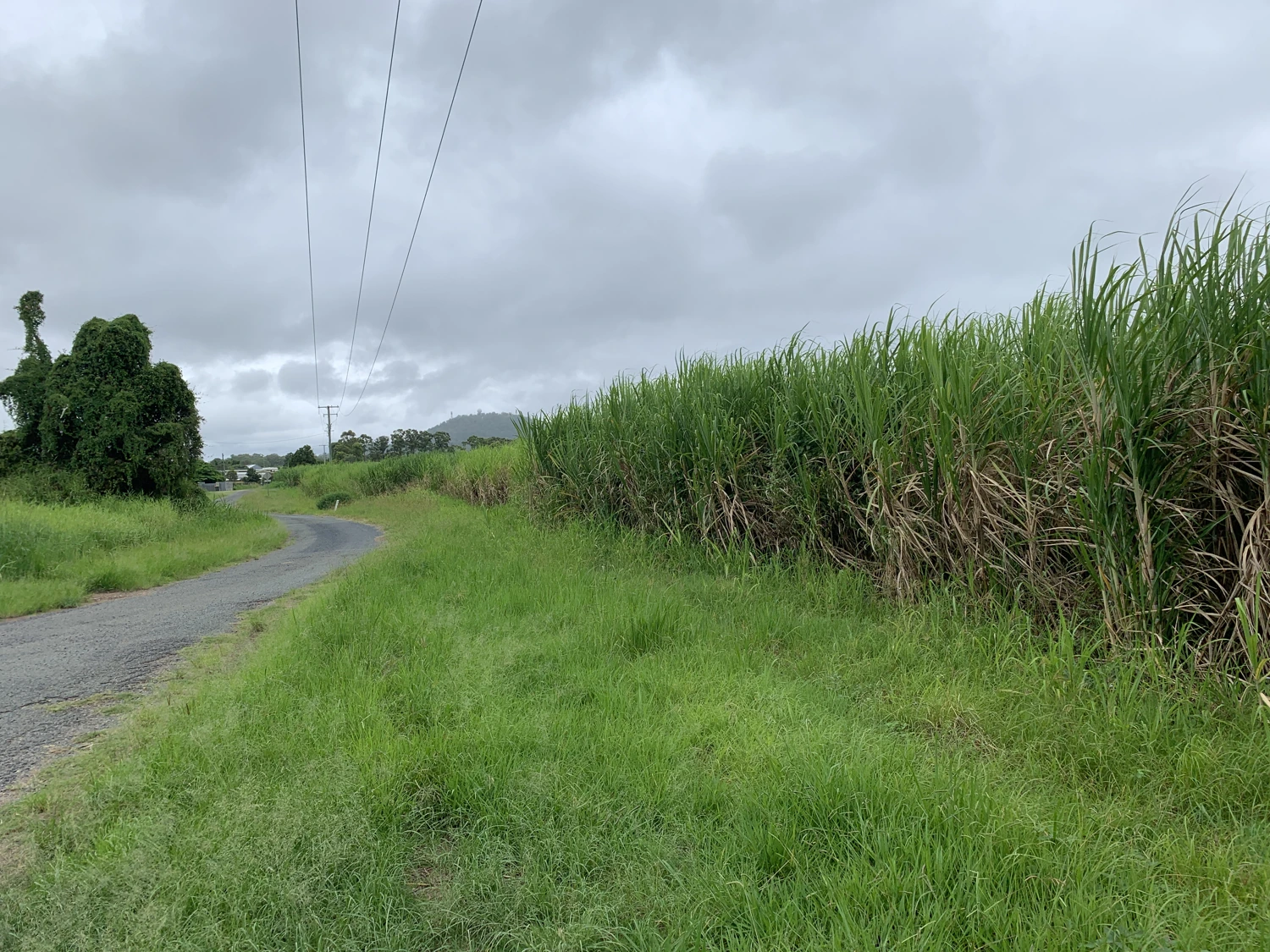
本章复用摄影者Kerry Raymond在2022年1月26日于澳大利亚昆士兰Alberton附近所摄甘蔗田原始照片。 文件逐字节SHA-256与原始Library影像台账一致,许可为CC BY 4.0。 照片展示道路旁蔗田与群体冠层,但没有温度传感器、出苗日、品种或叶数标签,故只能提供田间空间环境的真实上下文,不得作为任一度日参数的实验证据。 该图来自第001章现有资产,并非本章新下载。 [IMG-R1]
This chapter reuses the authentic photograph made by Kerry Raymond near Alberton, Queensland, on 26 January 2022. The photograph shows a roadside cane field and crop canopy, but includes no instrument record, emergence date, genotype or numbered leaves. It establishes real field context only and cannot validate a degree-day threshold. This is a reused Chapter 001 asset, not a newly downloaded image. [IMG-R1]
7.2 发育序列照片的证据门槛 / 7.2 Evidence thresholds for developmental sequences
可以证明“叶尖出现”“叶舌展开”或“分蘖峰值”的图片必须与标记个体、日期、温度累计方法和图号对应;如用显微图比较叶原基,必须保留比例尺、切面方向和制样条件。 纯粹美观的甘蔗田照片不能代替时间序列。 同一篇论文的多张照片可以相互印证器官形态,却仍只属于同一研究证据链;发表数据折线图另计为图表,不计为田间实景照片。
A photograph that claims to document visible tips, exposed ligules or peak tillering must identify tagged plants, dates, thermal accumulation and the original figure number. A micrograph of leaf primordia also needs a scale bar, section orientation and preparation conditions. A scenic cane field is no substitute for a dated sequence. Several photographs from one paper can show complementary morphology but remain in the same research chain; published data plots must be counted separately from field photographs.
7.3 许可与失败图片规则 / 7.3 Licence and failed-media rules
存档每幅图像的原始作者、授权条款、拍摄地点和日期的实际核实范围、原版字节SHA-256、图号、比例尺是否存在以及中英文图注。 本章没有新取得的完整可授权生长阶段照片,故新增图片数为0;未核实的候选图片不进入Word,也不计入拥有量。 遇到同一候选原件一次明确下载失败即登记缺口,不以AI合成图补充证据。
For each image keep its creator, licence, verified scope of date/place, original-byte SHA-256, figure identifier, presence or absence of a scale bar, and bilingual caption. No new licence-cleared developmental-stage photograph was acquired in this chapter: the count is zero. Unverified candidates are neither embedded nor counted. A clear failed attempt against the same original is logged once rather than retried through alternate URLs; generative illustrations are not substitute observations.
网页预览经过缩放或格式转换,未裁切;原比例尺与标签保留。 / Web preview resized or re-encoded without cropping; original scales and labels retained.
图006-01 澳大利亚昆士兰Alberton甘蔗田实景。 可观察田缘冠层,但原件没有发育日期、叶位、温度和品种记录,因此不用于估计积温。 摄影:Kerry Raymond,2022年1月26日,CC BY 4.0。
Figure 006-01. A sugarcane field near Alberton, Queensland. The crop canopy is visible, but the original image has no measured developmental date, leaf rank, temperature or cultivar, so it cannot estimate thermal time. Photo: Kerry Raymond, 26 January 2022, CC BY 4.0.
图像标签释义:原图未标注比例尺、叶位、处理区或温度仪器。 原件SHA-256:fc287e4f805052bee0d1a15c308152b87cc5bd804f4ddf208f4b908e72381fb2
There is no scale bar or experimental-treatment label; field context only.
八、适用范围、知识缺口与后续证据实验
VIII. Applicability, evidence gaps and next experiments
8.1 从两品种推断到世界蔗区 / 8.1 From a two-cultivar trial to global cane zones
澳大利亚的温控节形成参数、巴西亚热带田间出叶参数、南非宿根分蘖阈值与阿根廷蔗糖成熟积温,都回答各自材料、起点、环境和模型条件下的问题。 即使单位相同,也不能把这些数值拼接成“世界甘蔗统一发育表”。 试验对象至少需要涵盖不同种质背景、新植和不同代宿根、热带湿润与旱热地区、灌溉和雨养,才可讨论参数的可转移程度。 [S01,S02,S05,S07]
Temperature-controlled Australian node parameters, subtropical Brazilian leaf appearance, South African ratoon density thresholds and Argentine thermal sums to ripening answer different questions with different materials, origins, environments and models. Matching units do not justify assembling them into a universal sugarcane development table. Transferability requires tests across germplasm, plant cane and successive ratoons, humid tropical and hot/dry zones, and irrigated versus rainfed systems. [S01,S02,S05,S07]
8.2 热量解释的独立边界 / 8.2 Independent limits of the thermal explanation
积温模型能够在已验证的温区中改善日期预测,却不能单独解释与叶片数解耦的器官伸长、最终有效茎数、蔗糖浓度、成熟诱导或高温极端损伤。 尤其当田间发生干旱、涝渍、病害或营养限制时,以日均温拟合的表观基温可能吸收了非温度因素。 发生“温度基温显著漂移”时,应先检查事件定义和模型识别性,再考虑真正遗传变化。 [S03,S04,S06]
Thermal time can improve event-date prediction within a validated range but cannot alone explain organ elongation detached from leaf number, final millable stalk density, sucrose concentration, ripening induction or heat injury. Under drought, flooding, disease or nutrient limitation, an apparent threshold fitted from mean air temperature can absorb non-temperature effects. An apparent shift in base temperature first calls for checking event definitions and model identifiability, not immediately asserting genetic change. [S03,S04,S06]
8.3 建议的独立复核设计 / 8.3 Recommended independent validation design
选择具早熟、中熟和晚熟表现的多个品种,在温控试验中对每温度水平设置真正独立、可重复的气候箱或分期轮换,田间则跨地点—年份随机区组。 每区标记主茎并连续记录叶尖、叶舌、分蘖与节间伸长,保留逐时温度及土壤水分。 预先注册线性、分段、三基温非线性模型和相同留出验证方案,比较预测误差与参数稳定性;再以糖分取样验证“发育年龄不等于成熟”的命题。
Choose several early-, intermediate- and late-performing genotypes. In controlled trials, provide genuinely independent temperature application or replicate chamber rotations; in the field, use randomized blocks across sites and seasons. Tag primary stalks and repeatedly score tips, ligules, tillers and internode growth while preserving hourly temperature and soil water. Preregister linear, segmented and three-cardinal-temperature models with identical holdout tests, compare forecast errors and parameter stability, and independently sample sugar composition to test whether developmental age is distinct from ripeness.
8.4 与第005、007和第二卷的关系 / 8.4 Boundaries with Chapters 005, 007 and Volume II
第005章确立叶龄叶位和节位的标注方法;本章把这些可观测事件置于热量和日历时间的联合标尺。 第007章再用独立的鲜干物质量与分配数据讨论生长,不得把本章拟合的叶间积温视作物质积累率。 第二卷关于辐射和冠层微气候的研究将提供本章缺少的叶温、遮阴与光能测量链。 全书统一审核前本章为双语研究初稿,未获出版或网站上线批准。
Chapter 005 defines leaf-age, rank and internode annotation; the present chapter locates these observed events on aligned thermal and calendar clocks. Chapter 007 separately estimates mass accumulation and partitioning; the fitted phyllochron here must not be equated with biomass growth rate. Volume II on radiation and canopy microclimate will supply missing leaf temperature, shading and radiation measurements. Until whole-book review this chapter remains a bilingual research draft and is neither publication-ready nor live on the website.
附录 A|双语术语与测量口径 / Appendix A: Bilingual terminology
中文术语 | English term | 定义 / Usage |
|---|---|---|
日历年龄 | Calendar age | 从定义的起点计算日数 / Elapsed days from a declared origin |
生理年龄 | Physiological age | 依观察到的组织状态定义 / Defined by observed developmental state |
积温;有效积温 | Thermal time; growing degree-days | 按指定温度函数积分 / Temperature-response integral |
基温 | Base temperature (Tb) | 模型下限并非组织死亡温度 / Model lower threshold, not lethal temperature |
最适温度 | Optimum temperature (To) | 过程最高速率或平台范围 / Rate optimum or plateau |
上限温度 | Upper temperature limit (Tu) | 模型响应上限 / Model upper limit |
叶间积温 | Phyllochron | 同类出叶事件热间隔 / Heat interval between defined leaf events |
叶尖可见 | Visible leaf tip | 心叶筒中露出的叶尖 / Tip visible from the whorl |
叶舌可见 | Exposed ligule | 叶片完全展开标准之一 / One expanded-leaf convention |
节形成 | Node deposition / node appearance | 形成与外部识别需区别 / Formation differs from external visibility |
茎节伸长 | Internode elongation | 长度生长不同于节数增加 / Length growth versus node-number development |
宿根再生 | Ratoon regrowth | 收获后既有蔗蔸再萌发 / Regrowth from surviving stools |
分蘖死亡期 | Tiller mortality phase | 存活分蘖净减少阶段 / Period of declining live tiller count |
拟合基温 | Fitted base temperature | 根据观测估计 / Statistically estimated from observations |
设计基温 | Assumed base temperature | 研究预先选定 / Prespecified for analysis |
实验单位 | Experimental unit | 独立接受处理的最小单位 / Smallest independently treated unit |
观测子样本 | Nested subsample | 样区内重复测株 / Repeated plants nested within a plot |
伪重复 | Pseudoreplication | 非独立观测被当独立重复 / Subsamples treated as independent replicates |
低于最适温区 | Suboptimal temperature range | 线性热量可能近似有效 / Range where linear response may be reasonable |
超最适温区 | Supra-optimal temperature range | 热量增加不等于更快发育 / Heat need not raise response rate |
模型外推 | Model extrapolation | 超出验证材料及环境 / Prediction beyond validated scope |
附录 B|核读原始研究及官方资料 / Appendix B: Primary studies and official model
[S01] Inman-Bamber (1994). Temperature and seasonal effects on canopy development and light interception of sugarcane. Field Crops Research. DOI: 10.1016/0378-4290(94)90051-5. 访问:abstract_or_catalog_summary;定位:Abstract; methods and results summary; leaf and tiller thermal parameters。
Link: https://doi.org/10.1016/0378-4290(94)90051-5 | Material: NCo376 and N12 sugarcane ratoon crops, Natal South Africa | Limitation: Full original article not retrieved; repeated ratoon events must not automatically be counted as independent experiments.
[S02] Campbell, Robertson and Grof (1998). Temperature effects on node appearance in sugarcane. Australian Journal of Plant Physiology 25:815–818. DOI: 10.1071/PP98040. 访问:publisher_abstract;定位:Publisher abstract, lines 144–147。
Link: https://connectsci.au/fp/article-abstract/25/7/815/14505/Temperature-effects-on-node-appearance-in | Material: Australian sugarcane cultivars Q117, Q138; plants six months old | Limitation: Chamber and plant replication unavailable without full PDF; node appearance extrapolation limited by tested 14–26 °C.
[S03] Bonnett (1998). Rate of leaf appearance in sugarcane, including a comparison of a range of varieties. Australian Journal of Plant Physiology 25:829–834. DOI: 10.1071/PP98041. 访问:publisher_abstract;定位:Publisher abstract; nine varieties, ten-month pot experiment; predictive model comparison。
Link: https://doi.org/10.1071/PP98041 | Material: nine commercial sugarcane varieties; Townsville pots | Limitation: Predicted leaves at 5000 degree-days are model estimates; full-text design and independent units not retrieved.
[S04] Liu, Kingston and Bull (1998). A new technique for determining thermal parameters for phenological development in sugarcane, including suboptimum and supra-optimum temperature regimes. Agricultural and Forest Meteorology 90:119–139. DOI: 10.1016/S0168-1923(97)00087-7. 访问:abstract_or_catalog_summary;定位:Published abstract summary; process-specific base and optimum temperatures。
Link: https://doi.org/10.1016/S0168-1923(97)00087-7 | Material: Q138 and Q141, Australian sugarcane field experiments | Limitation: Underlying raw data and confidence intervals not retrieved; not poolable with chamber node threshold.
[S05] Streck, Hanauer, Gabriel, Buske and Langner (2010). Leaf development and growth of selected sugarcane clones in a subtropical environment. Pesquisa Agropecuária Brasileira 45(10). DOI: 10.1590/S0100-204X2010001000001. 访问:full_HTML_methods_results;定位:Abstract; Materials and Methods; Results; four-block plot design and leaf measurement methods。
Link: https://www.scielo.br/j/pab/a/vwMqWLVQCJqx7twMcGfCGtn/?format=html&lang=en&ilang=en | Material: IAC 822045, SP 711406, CB 4176; Santa Maria, RS, Brazil | Limitation: Years have different planting dates; article Results text appears internally inconsistent about phyllochron inequality versus verbal speed interpretation; do not infer raw observations from per-plant time series not downloaded.
[S06] Bonnett, Hewitt and Glassop (2006). Effects of high temperature on growth and composition of sugarcane internodes. Australian Journal of Agricultural Research 57:1087–1095. DOI: 10.1071/AR06042. 访问:publisher_abstract;定位:Publisher abstract: temperature contrast and internode number/length/sugar。
Link: https://doi.org/10.1071/AR06042 | Material: Q117 and Q158 sugarcane | Limitation: Exact chamber replication and complete response distributions not available from abstract.
[S07] Saez, Mariotti and Vega (2019). Source–sink relationships during early crop development influence earliness of sugar accumulation in sugarcane. Journal of Experimental Botany 70:5157–5171. DOI: 10.1093/jxb/erz251. 访问:full_PDF_viewed_online;定位:PDF printed p5159; Crop phenological development; Temporal dynamics of tillering; Table 1。
Link: https://repositorio.inta.gob.ar/bitstream/handle/20.500.12123/9880/INTA_CRTucuman-Santiago_EEAFamailla_Saez_JV_Source%E2%80%93sink_relationships_during_early_crop.pdf?isAllowed=y&sequence=1 | Material: 5 sugarcane hybrid genotypes; Famaillá Argentina, plant cane and two ratoon seasons | Limitation: PDF viewed legally online but not archived for redistribution; field and temperature experiment are distinct components of ONE publication; risk of temperature chamber pseudoreplication needs full recheck.
[S08] Vasantha, Gupta and Shekinah (2014). Physiological studies on tiller production and its senescence in sugarcane – response comparison between plant and ratoon crops. Indian Journal of Agricultural Sciences 84:24–27. DOI: 10.56093/ijas.v84i1.37145. 访问:publisher_abstract;定位:Abstract: cultivar, spacing, plant versus ratoon tillering duration。
Link: https://doi.org/10.56093/ijas.v84i1.37145 | Material: Co7805, Co91010, Co97008, Co98013 | Limitation: 120 versus 60 days is calendar time in a study, not globally transferable degree-day thresholds.
[S09] Knapp et al. (2020). Soma térmica para estabelecimento de novas cultivares de cana-de-açúcar. Agrometeoros 27(2). DOI: 10.31062/agrom.v27i2.26457. 访问:publisher_abstract;定位:Abstract: 15 genotypes, four blocks and emergence/four-leaf thermal sums。
Link: https://doi.org/10.31062/agrom.v27i2.26457 | Material: 15 Brazilian sugarcane genotypes reported | Limitation: No complete specimen identifiers or genotype means retrieved; source-reported number requires confirmation from full text.
[M01] Singels and Paraskevopoulos; South African Sugarcane Research Institute (2017). The Canesim Sugarcane Model: Scientific Documentation. SASRI model documentation. DOI: —. 访问:official_PDF_table_verified_by_screenshot;定位:PDF p21 (printed p17), Table 3.1 and Figure 3.1。
Link: https://sasri.org.za/wp-content/uploads/2020/03/The-Canesim-sugarcane-model-Scientific-documentation.pdf | Material: Canesim crop model, parameterization in NCo376 | Limitation: Model-parameter choices, not independent field experiments. Copyright restricts reproducing original figures. A separate model table may use a different initial emergence setting; record Table 3.1 only.
附录 C|证据合规与未完成项 / Appendix C: Audit limitations
• No unpublished plant-level temperature–leaf data acquired; all numeric values are published summaries/design/model parameters.
• Controlled-chamber replication and several field-plot counts unavailable in abstracts: not scored as known independent experiments.
• S02 Q138 Tb 7.6 °C vs S04 leaf Tb 16.9 °C must be compared only with aligned biological event and model.
• Streck full HTML has possible textual inequality/verbal interpretation inconsistency concerning early-vs-late phyllochron; no unqualified inequality reproduced.
• Canesim Table 3.1 may differ from a separate model-configuration example; stored parameters are tied to specific printed table.
• Only contextual reused field photograph available; an original licensed tagged phenology photo time series is still missing.
• Neither licensed original PDF nor published data-figure image was newly acquired or redistributed.
Claims are graded individually, numerical records preserve provenance, and unidentified experimental units or raw observations remain null. The evidence JSON provides exact source locators, conditions and missing-value reasons. All whole-book release gates remain closed.