中英文研究初稿 R1 | Bilingual research draft R1
证据核查日期 / Evidence review: 2026-11-10
核心问题:怎样把截获了多少光,与每单位截获能量形成了多少干物质分开? 本章以可核对的辐射、质量和时间边界连接冠层过程与田间产量,并保留原始研究之间的差异。
Core question: how can the amount of light captured be separated from dry matter formed per unit captured energy? This chapter links canopy processes and field yield through auditable radiation, mass and time boundaries, preserving differences among original studies.
读者要点 / Key distinction
截光更多 ≠ 转换效率更高 ≠ 最终糖产量更高
More interception ≠ higher conversion efficiency ≠ higher final sugar yield
状态:正文初稿及首轮来源核查;部分全文、独立重复和原始数据仍待补。
Status: draft text with initial source review; some full methods, replication and raw data remain outstanding.
本章导读 / Chapter guide
部分 / Part | 研究内容 / Content |
|---|---|
01 | 研究对象与核心问题 |
02 | 结构基础与过程机制 |
03 | 生育阶段与环境响应 |
04 | 品种及生态区差异 |
05 | 原始试验与相反证据 |
06 | 观测指标与测量方法 |
07 | 真实图像与数据证据 |
08 | 适用边界、复核与后续问题 |
公式中的B默认为指定组织的干物质,Q为同一边界下累计截获能量,ε为对应RUE。 DM表示干物质;SW表示总短波;PAR表示光合有效辐射。 示例中的数字均为教学假设,除非明确注明“发表结果”。
In the equations, B denotes dry matter of the specified tissue pool, Q cumulative intercepted energy on the same boundary, and ε the corresponding RUE. DM means dry matter, SW broadband shortwave and PAR photosynthetically active radiation. Example numbers are hypothetical unless explicitly identified as published results.
022.01 研究对象与核心问题
Objects and key questions
1.1 RUE研究的是转换关系,不是一个脱离条件的品种标签
RUE describes conversion, not an unconditional cultivar label
本章把群体辐射利用效率定义为:在明确的时间与空间边界内,某一生物量或碳量增量相对于指定辐射输入的比值或拟合斜率。 必须同时写明分子、分母、起止日期和估计方法。 只报告“RUE为2.5”既不能判断高低,也不能与另一试验比较。 [R01,R04,R06]
Here, crop radiation use efficiency is a ratio or fitted slope relating a specified biomass or carbon increment to a specified radiation input over defined spatial and temporal boundaries. The numerator, denominator, dates and estimator must be stated together. A value such as “RUE = 2.5” alone is not interpretable or comparable. [R01,R04,R06]
1.2 截光能力与转换效率是两个不同问题
Interception and conversion are separate questions
季节干物质形成可用逐时段的“截获能量×相应效率”相加表达。 更早封行可能增加截获能量,但不保证单位截获能量的干物质增量增加。 相反,冠层较小的处理即使算得较高RUE,也可能因为截光少而具有较低总产量。 判断处理优劣时应同时呈现能量、效率和最终生物量。 [R02,R08; editorial decomposition]
Seasonal dry-mass formation can be expressed as a sum of intercepted energy multiplied by its corresponding interval efficiency. Earlier closure may increase captured energy without improving conversion per unit energy. A smaller canopy may even have a higher calculated RUE but lower biomass because it captures less radiation. Report energy, efficiency and final biomass together. [R02,R08; editorial decomposition]
1.3 质量效率、碳效率和能量效率不能共用单位
Mass, carbon and energy efficiencies require different units
干物质RUE通常用g DM MJ⁻¹,碳通量效率用g C MJ⁻¹;能量转换效率则是无量纲比例或百分数。 鲜蔗质量含有水分,不能直接代替干物质。 总初级生产力、净生态系统生产力和地上干物质也有不同呼吸与组织边界,必须建立不同变量,不用固定系数强行合并。 [R04,R06,O01]
Dry-matter RUE is commonly expressed in g DM MJ⁻¹, carbon-flux efficiency in g C MJ⁻¹, and energy-conversion efficiency as a dimensionless fraction or percentage. Fresh cane includes water and is not dry matter. Gross primary production, net ecosystem production and aboveground dry mass have different respiratory and tissue boundaries and should remain separate variables. [R04,R06,O01]
1.4 四类估计对象
Four distinct estimands
本章区分区间RUE、全过程表观RUE、回归斜率RUE和最大区间RUE。 四者即使使用相同单位,统计含义也不同。 最大值来自多个区间的选择,容易受取样误差影响;全过程值包含不利时期;回归值取决于是否带截距及哪些时期入选。 数据库不只保存数字,还保存估计对象。 [R04,R05,R07; methodological synthesis]
We distinguish interval RUE, whole-cycle apparent RUE, regression-slope RUE and maximum interval RUE. Identical units do not make these interchangeable. A maximum is selected from several intervals and is sensitive to sampling error; a whole-cycle value includes unfavorable periods; a regression depends on its intercept and time window. The database stores the estimand as well as the number. [R04,R05,R07; methodological synthesis]
表022-01 估计对象与边界
Table 022-01. Estimands and boundaries
对象 / Estimand | 形式 / Form | 必须说明 / Required context |
|---|---|---|
区间 / Interval | εᵢ = (B₂−B₁)/Q₁→₂ | 两个日期、组织与土地面积 |
全过程 / Whole cycle | (B_end−B_start)/ΣQ | 起点存量;有些论文用B_end/ΣQ |
回归 / Regression | B = a + εQ | 截距、取样窗口与误差结构 |
最大区间 / Maximum interval | max(εᵢ) | 取样间隔、选择规则与不确定度 |
022.02 结构基础与过程机制
Structural basis and process mechanisms
2.1 从入射光到截获光,再到吸收光
From incident to intercepted to absorbed radiation
总短波、PAR能量与PAR光子量是不同量纲或波段的输入。 截获量表示未从下边界透过的部分,吸收量还要扣除冠层反射并处理下边界向上通量。 只测冠层上、下向下辐射时,宜称截获而不是已测得吸收。 冠层死叶和茎秆也可能改变通量,不能把全部截获都归给活绿叶。 [R04,O02,O03; boundary accounting]
Broadband shortwave energy, PAR energy and PAR photon quantity represent different spectral or dimensional inputs. Interception concerns the portion not transmitted downward through the lower boundary; absorption also requires reflected and upward boundary fluxes. With downward measurements above and below the canopy alone, describe interception rather than measured absorption. Stems and dead leaves can also alter the radiation budget. [R04,O02,O03; boundary accounting]
2.2 光谱换算必须保留条件
Spectral conversion is conditional
若同一时段、同一空间边界内的截获PAR能量与截获短波能量之比为r,则RUE_PAR=RUE_SW/r。 r不是任意取用的常数,更不等于所有天气下的入射PAR比例。 量子传感器记录的是光子通量,换成能量时需要光谱信息或注明适用范围的近似换算;照度lux不能直接作为RUE能量分母。 [R04,O02,O03; algebraic identity]
If intercepted PAR energy divided by intercepted shortwave energy is r for the same period and spatial boundary, then RUE_PAR = RUE_SW/r. This r is not an arbitrary universal constant or necessarily the incident PAR fraction. Photon flux requires spectral information, or an explicitly qualified approximation, for conversion to energy. Lux is not an energy denominator for RUE. [R04,O02,O03; algebraic identity]
表022-02 相同g MJ⁻¹背后的不同量
Table 022-02. Different quantities behind a common g MJ⁻¹ label
口径 / Basis | 可比较对象 / Comparable output | 不能混同 / Do not confuse |
|---|---|---|
入射SW / Incident SW | 干物质/入射能量 | 包含截光差异 |
截获SW / Intercepted SW | 干物质/截获短波 | 不是PAR能量 |
截获PAR / Intercepted PAR | 干物质/PAR能量 | 不是光子mol数 |
吸收PAR / Absorbed PAR | 匹配吸收边界的产出 | 不能把1−透光率直接当吸收 |
GPP效率 / GPP efficiency | g C / MJ | 不是地上干物质RUE |
2.3 生物量存量变化不等于所有组织的累计生产
Stock change is not total tissue production
相邻取样的地上干重差,反映取样时仍被回收的组织净变化。 脱落叶、死亡茎或移走组织未被回收时,存量差可能低于累计组织形成量。 应分别记录现存活体、附着死体、地表残体及移除量;只有具有独立测量时才能作质量平衡修正,不能用“预计枯叶”补成实测生物量。 [R02,R05,O01]
The difference between successive aboveground dry-mass samples measures net change in the tissue actually recovered. Unrecovered litter, dead stalks or removed material can make this smaller than cumulative tissue production. Record standing live tissue, attached dead tissue, surface litter and removals separately. Apply mass-balance corrections only when independently measured; estimated litter must not be relabeled as observed biomass. [R02,R05,O01]
2.4 呼吸、分配与储糖改变同一分母上的产出
Respiration, allocation and storage change output per unit energy
光合固定的碳还经历呼吸、根冠分配和不同组织合成,因此单叶同化速率不是地上干物质RUE。 较大蔗群可能维持更多非光合组织,但仅见后期RUE下降不能证明是维持呼吸增加所致。 糖产量还取决于进入可收获茎的比例、茎糖浓度及回收边界,需要与RUE分开验证。 [R05,R06,O01]
Fixed carbon subsequently undergoes respiration, root–shoot allocation and tissue synthesis, so single-leaf assimilation is not aboveground dry-matter RUE. A large crop may support more nonphotosynthetic tissue, but declining late-season RUE alone does not identify increased maintenance respiration as its cause. Sugar yield additionally depends on harvestable stalk allocation, sugar concentration and recovery boundaries. [R05,R06,O01]
2.5 动态光照通过时间积分进入RUE
Dynamic light enters RUE through time integration
第021章讨论的诱导滞后与光保护松弛,可能改变相同入射量下的碳同化过程;但从秒级叶片变化推到月尺度RUE,必须经过冠层面积、叶位、夜间损失及组织分配的整合。 月尺度RUE能用于检验综合结果,不能反向唯一识别其中某个酶或气孔过程。 [Cross-link C021; synthesis, not a new empirical effect]
Induction delays and photoprotection relaxation from Chapter 021 can alter assimilation under a given light input. Extrapolation from second-scale leaf responses to monthly RUE nevertheless requires integration over canopy area, leaf positions, nighttime losses and allocation. Monthly RUE can test an integrated outcome, but cannot uniquely identify an enzyme or stomatal mechanism. [Cross-link C021; synthesis, not a new empirical effect]
022.03 生育阶段与环境响应
Developmental stages and environmental responses
3.1 建苗期与快速生长期
Establishment and rapid growth
建苗期叶面积小、行间空隙大,按入射辐射计算的效率容易偏低;这是截光不足与转换能力共同作用的结果。 研究RUE时,应保存种植或收获后的时间零点,同时标明首次干物质测量。 种茎或宿根储备对早期增长的贡献未扣除时,不能把全部早期增量解释为当期光合形成。 [R02,O01; accounting qualification]
During establishment, small leaf area and wide gaps can lower efficiency calculated against incident radiation through both capture and conversion effects. Preserve the planting or harvest time origin and the first biomass date. When contributions from setts or ratoon reserves are not separated, early growth cannot be attributed entirely to concurrent photosynthesis. [R02,O01; accounting qualification]
3.2 新植与宿根差异不是全球固定折扣
Plant–ratoon differences are not a universal discount
澳大利亚两品种研究发现宿根早期积累快,而新植的最大RUE较高;2025年跨环境分析则未检出相同形式的总体作物类别效应。 两者所覆盖的材料、抽样时期及统计层级不同。 这不是选择某一篇“正确”的问题,而是提醒模型中的宿根折扣应按资料范围与版本说明。 [R02,R07,O01]
An Australian two-cultivar study combined faster early ratoon accumulation with higher maximum plant-crop RUE; the 2025 cross-environment analysis did not detect the same overall crop-class effect. Materials, sampling windows and statistical levels differ. Rather than choosing one as universally correct, document the evidence scope and model version behind any ratoon adjustment. [R02,R07,O01]
3.3 水分和氮素限制需要同时查看截光与生物量
Water and nitrogen constraints require both capture and biomass measurements
缺水可伴随叶面积变化和单位截光产出变化,两者必须分别测量。 斯里兰卡裂区试验说明灌溉与雨养条件下RUE可明显不同,但该结果不提供全球统一旱害系数。 对氮素也应保持同样谨慎:本章模型资料含氮限制功能,不等于本章已经获得独立的施氮剂量—RUE因果试验。 [R03,O01]
Water deficit may affect both canopy capture and output per captured energy, which must be assessed separately. The Sri Lankan split-plot experiment demonstrates different RUE under irrigated and rain-fed conditions, not a universal drought multiplier. Likewise, a nitrogen-limitation function in the model documentation is not an independently verified nitrogen-dose experiment in this chapter. [R03,O01]
3.4 温度响应不是单一叶温阈值
Temperature response is not a single leaf-temperature threshold
2025年研究比较了不同温度响应形式,并给出特定资料下的最适区间。 其输入包含区间平均气温,不应把拟合最适值变成全天必须保持的叶温,或作为灌溉启动阈值。 高温时水分、蒸汽压亏缺和呼吸也可能同步改变,实际田间解释需记录这些协变量。 [R07]
The 2025 study compared temperature-response formalisms and estimated an optimum range conditional on its datasets. Its inputs include interval-mean air temperature; the fitted optimum is neither a required all-day leaf temperature nor an irrigation trigger. Water status, vapor-pressure deficit and respiration may also change during heat, so field interpretation requires these covariates. [R07]
3.5 后期平台与反例
Late plateaus and counterexamples
后期仍在截光但现存干物质不再增加,会使全过程表观RUE下降。 澳大利亚汇总中这种现象较常见;夏威夷两块商业蔗田则保持了较稳定的第二年表现。 应比较组织回收、倒伏与枯死、滴灌和干湿条件、作物周期及观察方法,不把“老龄必降”或“长周期必优”写成定律。 [R05,R06]
Continued interception with little additional standing biomass reduces whole-cycle apparent RUE. This was common in the Australian reanalysis, whereas the two Hawaiian commercial fields maintained comparatively stable second-year performance. Compare tissue recovery, lodging and mortality, irrigation and moisture conditions, crop duration and observation method. Neither inevitable age decline nor universal superiority of long rotations is established. [R05,R06]
022.04 品种及生态区差异
Genotypic and ecological differences
4.1 品种比较必须先统一指标
Standardize the estimand before comparing cultivars
品种比较首先统一辐射波段、组织边界、测量周期和估计方法,再比较生理差异。 一个品种较早封行可能提高总截光量;另一个品种维持后期活茎可能提高全过程RUE。 用同一排序同时代表“最佳冠层”“最高转换效率”和“最高糖产量”会掩盖真实机制。 [R02,R07,R08]
Standardize spectral band, tissue boundary, measurement period and estimator before interpreting cultivar physiology. Earlier closure may improve capture, while retaining live stalks later may improve whole-cycle RUE. One ranking cannot automatically represent the best canopy, greatest conversion efficiency and highest sugar yield. [R02,R07,R08]
4.2 最大RUE的相近,不是已证明品种完全相同
Similar maximum RUE does not prove identical cultivars
2025年论文摘要强调最大RUE较一致,但结果段仍报告了较弱的总体品种效应,且有一组两两比较显著。 本章采用“最大区间RUE的品种分离较弱”,而不采用“所有品种无差异”。 未检出差异也不是等效性检验,更不能据此取消新品种田间验证。 [R07 Results 3.1, prose only]
The 2025 abstract emphasizes consistency in maximum RUE, but its results retain a weaker omnibus cultivar effect and one significant pairwise contrast. This chapter therefore describes weaker cultivar separation in maximum interval RUE, not identical values in every cultivar. Nonsignificance is not an equivalence test and does not remove the need for new-cultivar field validation. [R07 Results 3.1, prose only]
4.3 地区效应与试验体系效应
Regional and experimental-system effects
热带、亚热带与岛屿蔗区的温度、云量、作物周期和水分条件不同,同时历史研究也可能使用不同的传感器和组织回收方法。 数据库按国家或地区展示资料时,应保留这些条件;不要把测量分母造成的数值差异误作气候优势,也不要把留尼汪作为独立主权国家计数。 [R03,R06,R07]
Tropical, subtropical and island systems differ in temperature, cloudiness, crop duration and water regime; historical studies also differ in sensors and biomass recovery. Retain those conditions when presenting regional evidence. A numerical difference caused by the denominator is not a climatic advantage. Réunion is listed as a region, not counted as an additional sovereign state. [R03,R06,R07]
4.4 密植可能主要改变截获量
Closer spacing may primarily change intercepted energy
南非轮辐式行距试验的摘要报告RUE对行距未见明显响应,同时生物量与截光量随行距变化。 巴西两配置研究又缺少每配置的独立地块重复。 两个案例都不支持单凭某个较高RUE数值宣布密植普遍优越;机械通行、倒伏、茎群存活与最终收益仍需独立评价。 [R04,R08]
The South African wagon-wheel spacing study reported little RUE response despite changes in biomass and interception. The Brazilian two-configuration study described no independent plot replication within a spacing. Neither supports universal dense-planting superiority from a higher numerical RUE alone; machinery access, lodging, stalk survival and final returns still require evaluation. [R04,R08]
022.05 原始试验与相反证据
Original experiments and conflicting evidence
5.1 经典高投入试验:最大值不等于季节平均值
Classic high-input trials: maxima are not seasonal means
Muchow等在澳大利亚灌溉蔗田报告的1.75 g DM MJ⁻¹属于截获短波口径的最大RUE,不能与PAR口径数值直接排高低。 Robertson等随后显示早期优势可能被后期活茎损失抵消。 两项论文的独立性及与后续汇总的关系应沿数据谱系核对,引用次数不增加试验证据数量。 [R01,R02,R05]
The 1.75 g DM MJ⁻¹ reported by Muchow and colleagues is a maximum on an intercepted-shortwave basis, not directly rankable against PAR-based values. Robertson and colleagues subsequently showed that late live-stalk losses could offset early advantages. Audit the dataset lineage of these papers and later syntheses; repeated citation does not create additional experimental evidence. [R01,R02,R05]
5.2 有重复的水分试验与受限的空间比较
Replicated water treatments versus limited spatial comparisons
斯里兰卡研究报告两水分处理、八品种和三次重复,能够按主区—副区结构评价水分与材料响应。 巴西研究仅描述两个配置地块,其植物子样本不是独立的行距处理重复。 两者都具有信息价值,但能支持的推断范围不同;本章将“能否读到全文”和“因果证据强弱”分开登记。 [R03,R04]
The Sri Lankan study reports two water regimes, eight varieties and three replicates, supporting analysis within its main-plot/subplot hierarchy. The Brazilian study describes only two configuration plots; plant subsamples do not replicate spacing treatments. Both are informative, but their inference scopes differ. Full-text accessibility and causal evidence strength are recorded separately. [R03,R04]
5.3 现存生物量与通量观测提供互补证据
Standing biomass and flux observations are complementary
夏威夷研究结合通量塔、植株调查和卫星指标,给出了与部分后期衰减研究不同的结果。 通量法有连续观测优势,但仍需缺测填补、呼吸拆分和空间足迹匹配。 两座塔不是大量独立重复,也不能把净生态系统碳量不加转换地当作可收获地上干物质量。 [R06]
The Hawaiian study combined flux towers, biometric observations and satellite indices and contrasted with some late-decline studies. Flux measurements improve temporal coverage but still require gap filling, respiratory partitioning and footprint matching. Two towers are not many independent replicates, and net ecosystem carbon cannot be equated directly with harvestable aboveground dry matter. [R06]
5.4 大数据汇总也需要检查来源重叠
Large syntheses still require overlap checks
2025年的40品种分析使用既有田间试验资料,并关联开放代码。 它扩大了可比较的环境范围,但不意味着本章获得了40份独立原始试验,也不意味着所有输入数据均公开。 全书应按原试验、地块、年份和数据版本追溯复用关系;代码登记与论文各计一项资源,不计两次实证验证。 [R07,D01]
The 2025 forty-variety analysis reused existing field datasets and linked open code. It broadens environmental comparison but does not mean this chapter acquired forty independent raw experiments or that every input dataset is public. Track reuse by original trial, plot, year and version. The code record and paper are two resources, not two empirical validations. [R07,D01]
表022-03 原始研究比较;RUE单位为g DM MJ⁻¹,分母按各行说明
Table 022-03. Study comparison; RUE in g DM MJ⁻¹ on the stated radiation basis
来源 / Source | 体系 / System | 报告结果 / Result | 边界 / Boundary |
|---|---|---|---|
R01 | 澳大利亚灌溉;最大值 | 1.75;截获短波 | 全文重复层级待核 |
R02 | 两品种新植/宿根 | 1.72 / 1.59;波段待核 | 最大值、非季节平均 |
R03 | 斯里兰卡水分裂区 | 1.63–2.09 / 0.71–1.03 | 范围非置信区间 |
R04 | 巴西两行距配置 | 2.73 / 2.78;截获PAR | 每配置仅一地块 |
R05 | 14项旧试验再分析 | 后期下降常见 | 选择与数据复用 |
R06 | 夏威夷两商业田 | 1.15–1.24;截获太阳能 | 第二年未明显下降 |
R07 | 40品种、多环境 | 表观与最大值分开 | 旧数据与模型拟合 |
R08 | 南非轮辐行距 | 均值1.50;波段待核 | 独立重复待核 |
022.06 观测指标与测量方法
Variables and measurement methods
6.1 辐射观测的最低条件
Minimum radiation-observation requirements
本章建议在代表性地块上同步测量冠层上方与冠层下方辐射,并覆盖行内、行间和不同方位;记录传感器波段、序列号、校准日期、安装平面和遮挡。 仪器原始光子单位不能悄悄改成能量单位。 以短时午间测量估计全天截获时,必须登记外推方法及验证缺口。 [O02,O03; proposed protocol]
Our proposed protocol synchronizes above- and below-canopy radiation across representative within-row, inter-row and directional positions. Record spectral range, sensor serial number, calibration date, receiving plane and obstruction. Never silently convert photon units to energy. Extrapolation from midday campaigns to a full day requires an explicit method and validation status. [O02,O03; proposed protocol]
6.2 传感器适用范围比型号名称更重要
Operating limits matter more than instrument names
厂商明确提醒某些硅光电总辐射传感器在植被下、反射光或人工光下可能不准确。 这类限制对“冠层上下做比值”特别重要:上下光谱并不相同,误差未必相消。 应针对用途选取校准和光谱响应合适的仪器,并将校准不确定度与空间采样误差分别报告。 [O02,O03]
The manufacturer warns that some silicon global-radiation sensors may be inaccurate beneath vegetation, in reflected light or under artificial sources. This particularly matters for above/below-canopy ratios: their spectra differ, so errors need not cancel. Select calibration and spectral response suitable for the task, and separate calibration uncertainty from spatial sampling error. [O02,O03]
6.3 干物质测量需要可核对的面积分母
Dry-mass measurements need auditable area denominators
记录取样实际行长、行数、行距定义和边界株处理;双行配置应按代表的土地面积换算,而不是随意选一条较窄行距。 各器官分别称鲜重和取样烘干,记录干燥温度、持续时间与恒重判据。 独立破坏性取样区域不应因前次取样开口改变后续冠层而仍被当作完整处理。 [R03,R04; proposed protocol]
Record actual harvested row length, number of rows, spacing convention and border treatment. Paired rows must be converted using represented land area rather than one narrow spacing. Weigh fresh organs and determine dry fractions separately, retaining drying temperature, duration and constant-mass criteria. Avoid treating later samples as undisturbed after earlier destructive openings alter the canopy. [R03,R04; proposed protocol]
6.4 先对时间和空间,再计算效率
Align time and space before computing efficiency
区间RUE=ΔB/ΔQ;干物质增量与累计截获辐射必须对应相同日期和土地面积。 光子日积分是mol m⁻²,而能量日积分是MJ m⁻²,两者不可混填。 气象站距地块较远、通量塔足迹跨越边界或卫星像元包含道路时,应记录空间不匹配,而不是把数值当作完全同位观测。 [R06,O02,O03; dimensional accounting]
Interval RUE equals ΔB/ΔQ, with biomass and intercepted energy aligned to identical dates and ground area. Daily photon integrals are in mol m⁻², whereas energy integrals are in MJ m⁻². Distant weather stations, tower footprints crossing field boundaries and satellite pixels containing roads create spatial mismatch that must be documented. [R06,O02,O03; dimensional accounting]
6.5 回归拟合不能默认过原点
A regression should not pass through zero by default
推荐同时检查B=a+εQ与通过原点模型。 若观测开始时已有生物量,或种茎/宿根储备贡献明显,强制a=0会改变斜率。 累计数据有共同时间趋势,较高R²不能证明独立机制;报告残差、置信区间、异方差及阶段变化,并按独立地块而非取样日期开展重复层级分析。 [R04; statistical reasoning and proposed analysis]
Compare B = a + εQ with a zero-intercept model rather than assuming the latter. Existing biomass at the first observation or reserve contributions can change the slope when a is forced to zero. Cumulative series share a time trend, so a high R² alone does not establish mechanism. Examine residuals, confidence intervals, heteroscedasticity and stage changes at the independent-plot level. [R04; statistical reasoning and proposed analysis]
6.6 全过程值是能量加权,不是简单平均
Whole-period RUE is energy-weighted, not an arithmetic average
在组织边界一致且无遗漏收支时,总RUE=Σ(εᵢQᵢ)/ΣQᵢ。 各时期截获能量相等时,两种平均必然等价;能量不等时一般不等价,不能默认用算术平均替代。 相邻区间若共享一次生物量测量,其误差还会相关;不能把这些区间当作彼此独立样本去人为缩小不确定度。 [Algebraic derivation; R07 estimator context]
With consistent tissue boundaries and accounted fluxes, total RUE = Σ(εᵢQᵢ)/ΣQᵢ. Equal intercepted energy guarantees equivalence with the arithmetic mean; unequal energy generally does not, so the arithmetic mean is not a default substitute. Adjacent intervals sharing a biomass observation also have correlated errors and must not be treated as independent samples to shrink uncertainty. [Algebraic derivation; R07 estimator context]
6.7 误差传播与负值
Uncertainty propagation and negative values
对ε=ΔB/Q,一阶相对方差约为Var(ΔB)/ΔB²+Var(Q)/Q²−2Cov(ΔB,Q)/(ΔB·Q)。 当ΔB接近零时,此近似不稳定,应直接检查原始收支、用区间或重抽样描述不确定度。 若现存生物量下降,负的存量RUE不等于“光合作用变成负效率”;优先核对组织损失、面积换算和取样误差。 [Mathematical derivation; R02,R05]
For ε = ΔB/Q, the first-order relative variance is approximately Var(ΔB)/ΔB² + Var(Q)/Q² − 2Cov(ΔB,Q)/(ΔB·Q). Near zero biomass change, this approximation is unstable; inspect the mass budget and use intervals or resampling. Negative standing-stock RUE does not mean negative photosynthetic conversion: check tissue loss, area conversion and sampling error first. [Mathematical derivation; R02,R05]
表022-04 数据库必须保留的字段
Table 022-04. Required data fields
字段组 / Group | 字段及意义 / Fields and meaning |
|---|---|
身份 / Identity | source_doi, study_id, plot_id, cultivar, crop_class, cycle_id |
时间与面积 / Time/area | start_date, end_date, sampled_area_m2, radiation_footprint |
分子 / Numerator | tissue_pool, dry_mass_method, litter_recovery, B_start, B_end |
分母 / Denominator | spectral_band, incident/intercepted/absorbed, sensor, unit, Q |
估计 / Estimation | estimator, intercept, sampling_window, uncertainty, n_hierarchy |
来源性质 / Provenance | reported_design / published_summary / model_parameter / raw / illustrative |
6.8 计算示例:检验口径,而不是制造观测
Worked examples: audit conventions, not fabricate observations
分母改变,数字就改变 / Changing the denominator changes the number
同一干物质增量得到1.50与3.33;不是生理效率提高。 假定截获PAR/短波=0.45。
The same mass gives 1.50 and 3.33; this is not a physiological improvement. Intercepted PAR/shortwave is assumed to be 0.45.
不同阶段按能量加权 / Weight stages by intercepted energy
两段增量为800与1200 g m⁻²;合计2000/1600=1.25,而不是1.50。
The increments are 800 and 1200 g m⁻². Their combined ratio is 2000/1600 = 1.25, not the arithmetic mean 1.50.
既有生物量与强制过原点 / Existing biomass and a forced-zero regression
数据满足B=200+1.5Q;强制过原点得到2.357。 不同斜率来自模型假设,不是新增试验。
The data follow B = 200 + 1.5Q. Forcing zero gives 2.357; the difference reflects an estimator assumption, not a new experiment.
质量效率转成化学能效率 / Convert mass efficiency to chemical-energy efficiency
2.8×0.016=0.0448,即4.48%;分母仍是原RUE的同种能量,不会自动变成入射太阳能。
2.8 × 0.016 = 0.0448, or 4.48%. The denominator remains the energy basis of the original RUE, not automatically incident solar energy.
表022-05 四组教学计算;B为g DM m⁻²,Q为MJ m⁻²
Table 022-05. Hypothetical calculations; B in g DM m⁻², Q in MJ m⁻²
示例 / Example | 输入 / Input | 结果 / Result |
|---|---|---|
1. 分母 / Denominator | ΔB=3000;Q_SW=2000;Q_PAR=900 | 1.50 vs 3.33 g MJ⁻¹ |
2. 加权 / Weighting | Q=[400,1200];ε=[2,1] | 总 / Total =1.25;非 / not 1.50 |
3. 截距 / Intercept | Q=[100,200,300];B=[350,500,650] | a自由 / free:1.50;a=0:2.357 |
4. 化学能 / Chemical energy | ε=2.8;h=0.016 MJ g⁻¹ | η=0.0448=4.48% |
022.07 真实图像与数据证据
Authentic images and data evidence
7.1 照片证据与定量证据分开
Separate photographic from quantitative evidence
本章复用已保存的甘蔗田原图,仅用于说明冠层与观测现场背景。 照片不含同期辐射、干物质或取样面积记录,因此不是某个RUE数值的证据。 同一照片在多章出现仍只算一项媒体,不新增田间试验;原文件校验值和许可元数据继续保留。 [M01, inherited media record]
The saved cane-field photograph is reused only as canopy and observation-site context. Without concurrent radiation, dry mass and sampled-area records, it does not substantiate a RUE value. Reuse across chapters remains one media item, not a new experiment; the original file hash and inherited license metadata are retained. [M01, inherited media record]
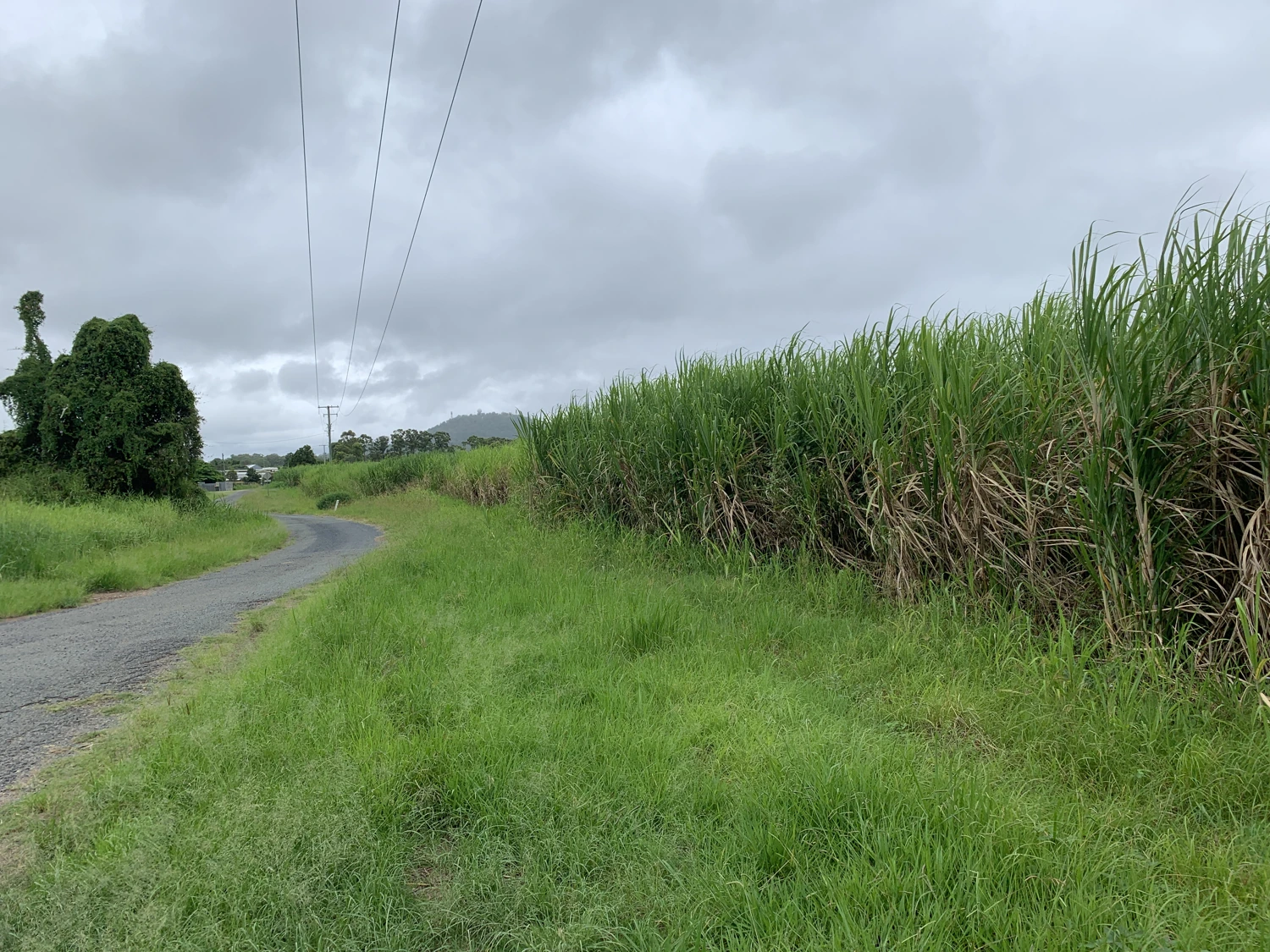
网页预览经过缩放或格式转换,未裁切;原比例尺与标签保留。 / Web preview resized or re-encoded without cropping; original scales and labels retained.
图022-01 甘蔗冠层与田间观测背景。 照片没有同步辐射、干物质或地块面积数据,不能用于估算RUE。 摄影:Kerry Raymond,2022年1月26日,CC BY 4.0。 Figure 022-01. Sugarcane canopy as field-observation context. No synchronized radiation, dry-mass or plot-area measurements accompany this image; it cannot estimate RUE. Photo: Kerry Raymond, 26 January 2022, CC BY 4.0.
原始来源 / Original source: https://commons.wikimedia.org/wiki/File:Sugarcane_fields,_looking_south_down_Cane_Farm_Road,_Alberton,_2022_01.jpg
许可 / License: https://creativecommons.org/licenses/by/4.0/
原图未改动;仅在文档中按比例显示。 / Original unchanged; scaled for display only.
7.2 真正需要补拍的四类影像
Four priority photographic records
后续应获取同一地块的辐射传感器安装与校准照片、带尺度的破坏性取样范围、器官分样与烘干称量、倒伏和残体回收记录。 每张图与地块编号、时间戳、仪器记录和相应数据行关联。 示意图可解释计算,但不能替代真实处理和对照影像。 [Proposed evidence-acquisition protocol]
Priority images are sensor installation/calibration, scaled destructive-sampling areas, organ separation and dry-mass weighing, and lodging/litter recovery. Link each to plot ID, timestamp, instrument record and corresponding data rows. A diagram can explain a calculation but cannot replace photographs of real treatments and controls. [Proposed evidence-acquisition protocol]
7.3 本章获取边界
Acquisition boundaries in the source review
本章核读了网页及PDF解析文字,但有关PDF截图和两份原始全文的本地下载未成功,故没有新取得的论文PDF、图表原件或原始观测数据。 未从未核验的PDF图表数字化取值;数值台账中的论文结果仅来自清晰的摘要或正文段落。 开放代码仅登记线索,未声称已经下载或运行。 [R03,R06,R07,O01,D01; access log]
This round inspected web content and parsed PDF text. Relevant PDF screenshots and two local full-text downloads failed, so no new source PDF, original figure file or raw observations were acquired. No unverified PDF table or graph was digitized; published numbers come only from readable abstracts or prose. The open-code resource is a lead, not claimed as downloaded or executed. [R03,R06,R07,O01,D01; access log]
022.08 适用边界、复核与后续问题
Applicability, review and further questions
8.1 如何判断一个RUE差异值得解释
When a RUE difference is interpretable
先检查单位、组织、时间、面积和拟合方法是否可比,再检查独立重复与不确定度,最后讨论机制。 显著性不是唯一尺度,还应看效应量、测量误差和产量意义。 本章保留未核实的辐射波段、误差类型和重复数,不把空值写成零,也不制造“全球最佳RUE”排行榜。 [Evidence synthesis]
First verify units, tissues, dates, area and estimator; next examine independent replication and uncertainty; only then discuss mechanism. Significance is not the sole criterion: consider effect size, measurement error and yield relevance. Unverified wavebands, uncertainty types and replicate counts remain missing rather than zero; no global best-RUE ranking is constructed. [Evidence synthesis]
8.2 试验与模型分别验收
Validate experiments and models separately
模型参数可能因枯叶回收修正、经验校准或所表示的器官集合而高于实测斜率。 检验模型时同时核对截光、干物质分配和最终产量;不要用调高RUE掩盖叶面积或水分模块误差。 校准数据与独立检验数据应明确分开,参数不能反过来被登记成田间观测值。 [O01,R07; proposed validation]
Model parameters may exceed measured slopes because of litter-recovery corrections, calibration or different represented organs. Validate interception, biomass allocation and final yield together; raising RUE must not conceal leaf-area or water-module errors. Separate calibration from independent testing, and never register a fitted parameter as a field observation. [O01,R07; proposed validation]
8.3 从RUE到生产目标
From RUE to production goals
研究目标是糖、饲料、纤维或能源时,最终评价对象不同。 能量蔗的高干物质量不自动等于高可制糖量;成熟期水分改变也会影响鲜蔗质量。 应用层应并列报告干物质产量、糖产量、耗水和稳定性,明确成本与机械化约束,而不是只优化一个分母较小的效率比值。 [R04,R06; interpretation]
Sugar, feed, fiber and energy objectives require different endpoints. High energy-cane dry mass does not automatically imply high recoverable sugar, and ripening water changes affect fresh cane mass. Applied evaluation should report dry-matter yield, sugar yield, water use and stability alongside costs and mechanization constraints, not optimize a ratio merely by shrinking its denominator. [R04,R06; interpretation]
8.4 章节衔接与研究缺口
Chapter links and research gaps
本章承接第016—017章的叶面积与截光、第021章的动态同化;第023章将解释能量平衡、叶温与边界层,第036章展开呼吸收支,第172章处理通量测量。 优先补足逐小区生物量—辐射配对数据、组织损失收支及跨季节独立检验;本章仍为有明确缺口的研究初稿。 [Chapter cross-references and editorial status]
This chapter builds on leaf area and interception in Chapters 016–017 and dynamic assimilation in 021. Chapter 023 addresses energy balance, leaf temperature and boundary layers; 036 treats respiration and 172 flux measurement. Priorities are plot-level paired biomass–radiation records, tissue-loss budgets and independent cross-season tests. This remains a research draft with explicit gaps. [Chapter cross-references and editorial status]
双语术语表 / Bilingual glossary
表022-06 术语及推荐英文表达
Table 022-06. Terms and recommended English equivalents
中文 | English | 中文 | English |
|---|---|---|---|
辐射利用效率 | radiation use efficiency (RUE) | 表观辐射利用效率 | apparent radiation use efficiency |
最大区间效率 | maximum interval efficiency | 回归斜率 | regression slope |
入射辐射 | incident radiation | 截获辐射 | intercepted radiation |
吸收辐射 | absorbed radiation | 总短波辐射 | broadband shortwave radiation |
光合有效辐射 | photosynthetically active radiation (PAR) | 光子通量密度 | photon flux density |
辐射能积分 | integrated radiant energy | 辐射截获比例 | fraction of intercepted radiation |
消光系数 | extinction coefficient | 叶面积指数 | leaf area index |
地上干物质 | aboveground dry matter | 现存生物量 | standing biomass |
组织生产 | tissue production | 残体回收 | litter recovery |
质量平衡 | mass balance | 净同化 | net assimilation |
总初级生产力 | gross primary production (GPP) | 净生态系统生产力 | net ecosystem production (NEP) |
维持呼吸 | maintenance respiration | 器官分配 | organ allocation |
比燃烧热 | specific heat of combustion | 能量转换效率 | energy conversion efficiency |
强制过原点 | forced-zero-intercept fit | 能量加权平均 | energy-weighted mean |
独立试验单位 | independent experimental unit | 子样本 | subsample |
裂区设计 | split-plot design | 轮辐式设计 | wagon-wheel design |
通量足迹 | flux footprint | 校准不确定度 | calibration uncertainty |
测量误差协方差 | measurement-error covariance | 参数可识别性 | parameter identifiability |
原始观测 | raw observation | 模型参数 | model parameter |
原始来源与核读范围 / Original sources and access scope
[R01] Muchow RC; Spillman MF; Wood AW; Thomas MR (1994). Radiation interception and biomass accumulation in a sugarcane crop grown under irrigated tropical conditions.
DOI: 10.1071/AR9940037
核读范围 / Access: PUBLISHER_ABSTRACT
定位 / Locator: Publisher abstract, paragraphs 2–4
[R02] Robertson MJ; Wood AW; Muchow RC (1996). Growth of sugarcane under high input conditions in tropical Australia. I. Radiation use, biomass accumulation and partitioning.
DOI: 10.1016/0378-4290(96)00041-X
https://www.sciencedirect.com/science/article/abs/pii/037842909600041X
核读范围 / Access: PUBLISHER_INDEXED_ABSTRACT
定位 / Locator: Original publisher indexed abstract, numbered findings 1–5
[R03] De Silva ALC; De Costa WAJM (2012). Growth and Radiation Use Efficiency of Sugarcane Under Irrigated and Rain-fed Conditions in Sri Lanka.
DOI: 10.1007/s12355-012-0148-y
核读范围 / Access: FULL_PDF_TEXT_TABLE_IMAGES_UNVERIFIED
定位 / Locator: Printed pp.247–249: Abstract; Materials and Methods
[R04] Ferreira Junior RA; de Souza JL; Lyra GB; Escobedo JF; Santos MVC (2015). Energy conversion efficiency in sugarcane under two row spacings in northeast of Brazil.
DOI: 10.1590/1807-1929/agriambi.v19n8p741-747
https://www.scielo.br/j/rbeaa/a/KKCQy59XVwyXbMb6KcgFV8K/?lang=en
核读范围 / Access: FULL_HTML_RELEVANT_METHODS_AND_RESULTS
定位 / Locator: Material and Methods: planting; radiation; dry matter; RUE regression; Abstract
[R05] Park SE; Robertson M; Inman-Bamber NG (2005). Decline in the growth of a sugarcane crop with age under high input conditions.
DOI: 10.1016/j.fcr.2005.01.025
https://ueaeprints.uea.ac.uk/id/eprint/62212/
核读范围 / Access: AUTHOR_INSTITUTION_ABSTRACT
定位 / Locator: Author repository abstract
[R06] Anderson RG; Tirado-Corbalá R; Wang D; Ayars JE (2014). Long-rotation sugarcane in Hawaii sustains high carbon accumulation and radiation use efficiency in 2nd year of growth.
DOI: 10.1016/j.agee.2014.09.012
https://www.ars.usda.gov/arsuserfiles/20361500/pdf_pubs/P2463.pdf
核读范围 / Access: FULL_PDF_TEXT_TABLE_IMAGES_UNVERIFIED
定位 / Locator: Abstract; Methods 2.1–2.3, especially RUEb and RUEg definitions
[R07] Christina M; Clark D; Marin FR; Ribeiro RV; Saez JV; Chibarabada TP; Vianna MS; Jones MR; Cuadra SV; Cabral OMR; Acreche MM; Dias HB (2025). Sugarcane radiation use efficiency: varietal differences, temperature dependence, and implications for modeling biomass across environments.
DOI: 10.1016/j.agrformet.2025.110854
https://repositorio.usp.br/bitstreams/8ec51f9b-a922-4185-872c-e7017d4ab990
核读范围 / Access: FULL_PDF_TEXT_TABLE_IMAGES_UNVERIFIED
定位 / Locator: Abstract; glossary; Methods 2.4; Results 3.1–3.3; Data availability
[R08] Singels A; Smit MA (2009). Sugarcane response to row spacing-induced competition for light.
DOI: 10.1016/j.fcr.2009.04.015
https://www.sciencedirect.com/science/article/pii/S0378429009001063
核读范围 / Access: PUBLISHER_INDEXED_ABSTRACT
定位 / Locator: Publisher indexed abstract
[O01] APSIM Initiative (2021). APSIM Sugarcane model description, archived 2021.04.07.5628 build.
官方技术资料 / Official technical documentation
https://apsimdev.apsim.info/ApsimX/Releases/2021.04.07.5628/Sugarcane.description.pdf
核读范围 / Access: OFFICIAL_PDF_TEXT
定位 / Locator: Crop growth, radiation interception and aboveground biomass pools
[O02] LI-COR (n.d.). LI-190R and LI-191R Quantum Sensor: Performance Characteristics.
官方技术资料 / Official technical documentation
https://www.licor.com/support/LI-190R-and-LI-191R/topics/quantum-performance.html
核读范围 / Access: OFFICIAL_HTML
定位 / Locator: Calibration and Quantum Spectral Response
[O03] LI-COR (n.d.). LI-200R Pyranometer: General Information.
官方技术资料 / Official technical documentation
https://www.licor.com/support/LI-200R/topics/200r-general-information.html
核读范围 / Access: OFFICIAL_HTML
定位 / Locator: General Information; Important Note; Table 1-1
[D01] Christina M (2025). Scripts and code for the 2025 sugarcane RUE paper: linked repository lead.
DOI: 10.5281/zenodo.17048654
https://doi.org/10.5281/zenodo.17048654
核读范围 / Access: ARTICLE_DATA_AVAILABILITY_AND_CIRAD_RECORD_ONLY
定位 / Locator: R07 Data availability and references; CIRAD notice 614730
文献数、数据资源数和独立试验数分别统计。 本章没有取得可重分析的逐株、逐小区或逐时原始数据;教学计算独立于发表观测。 本章首次核查不构成独立专家审定或全书统一审核。
Papers, data resources and independent experiments are counted separately. No reanalyzable plant-, plot- or time-level raw dataset was acquired. Teaching calculations are separate from published observations. Initial editorial checking is not independent expert approval or whole-book review.