正文初稿 R1 证据核查截至2026年11月8日
Chapter draft R1 Evidence reviewed through 8 November 2026
本章为全书建立共同的问题语言:以明确的甘蔗材料为对象,把器官活动、群体结构、环境过程和最终生产结果连接起来,并为每一项解释保留可以检查的证据。 光合作用、分蘖、伸长、成熟、糖分积累和逆境响应分别形成研究主线,又通过碳、水、养分、发育和时间相互联系。
This chapter establishes a common language for the encyclopedia. It connects organ activity, crop structure, environmental processes and production outcomes in explicitly identified sugarcane material, with evidence that can be checked. Photosynthesis, tillering, elongation, ripening, sugar accumulation and stress responses form distinct research themes, connected through carbon, water, nutrients, development and time.
本章的定义、问题矩阵和数据规则属于本百科的编写与研究框架;具体试验案例以原始论文为依据。 读完本章,应能把“某品种长得好”改写为带有比较对象、观测尺度、时间范围和可测结果的研究问题,并判断现有证据能支持到哪一步。
The definitions, question matrix and data conventions are the encyclopedia’s research and editorial framework. Experimental examples are attributed to original studies. Readers should be able to turn a statement such as “this cultivar grows well” into a question with a comparator, observation scale, time interval and measurable outcome, and identify how far the available evidence supports an explanation.
本章以可核验的问题连接材料、过程与结果。
This chapter links material, process and outcome through testable questions.
001 01 研究对象与核心问题
Objects and key questions
1 研究对象必须可以重新识别
1 Research material must be identifiable
本百科将甘蔗生理生态学界定为:研究甘蔗的结构、功能和发育如何随环境及管理条件变化,以及这些变化怎样形成资源利用、存活、生长和糖分积累的结果。 一个完整的研究对象,至少包含材料身份、繁殖来源、作物周期、器官位置、发育状态、所处环境和观测时间。 只写“甘蔗”不足以支持跨研究比较。
Here, sugarcane ecophysiology concerns how sugarcane structure, function and development respond to environmental and management conditions, and how those responses produce resource use, survival, growth and sugar accumulation. An identifiable research object includes material identity, propagation origin, crop cycle, organ position, developmental state, environment and observation time. The label “sugarcane” alone is insufficient for comparison across studies.
本章约定区分基因型、分株、茎秆和蔗蔸。 基因型标识遗传材料;分株指无性繁殖形成的植株单位;茎秆用于记录单茎生长及收获量;蔗蔸用于描述共同着生和管理的芽、茎及根系单元。 不同研究对计数单位的定义可能不同,入库时保留原定义,再建立映射,不把“株”“茎”“蘖”自动互换。
The chapter distinguishes genotype, ramet, stalk and stool. Genotype identifies genetic material; ramet identifies a vegetatively produced plant unit; stalk supports individual-stem growth and harvest measurements; stool identifies the associated buds, shoots and roots treated as a management unit. Because studies may define counting units differently, records retain the original definition before mapping it to a shared vocabulary.
新植蔗与宿根蔗的记录也须分开。 写明种植日期或上次收获日期、宿根代数及供种材料经历,才能判断比较的是同一发育窗口、同一生产周期,还是不同的历史背景。 本章不设一个可替代所有地方定义的统一日龄阈值。
Plant cane and ratoon cane require separate records. Planting date or previous harvest date, ratoon number and propagation history are needed to establish whether a comparison concerns the same developmental window, production cycle or historical background. No single age threshold is imposed as a substitute for locally defined stages.
2 六条主线的可检验问题
2 Testable questions across the six themes
下列问题是后续章节的共同入口,不是预先成立的答案。 每条主线同时设置过程指标和结果指标,避免只测到一个容易测量的变量,就把它解释为整套功能。
The questions below are entry points for later chapters, not conclusions assumed in advance. Each theme pairs process measurements with outcome measurements so that one convenient variable is not treated as the entire function.
主线 Theme | 核心问题 Core question | 配套观测 Paired observations |
|---|---|---|
光合作用 Photosynthesis | 资源变化如何影响碳同化,变化能否持续并传递到群体? How do resources alter assimilation, and does the response persist at crop scale? | 叶片气体交换、冠层受光、叶面积及后续生物量。 Leaf gas exchange, canopy light, leaf area and subsequent biomass. |
分蘖 Tillering | 芽的萌发、分蘖出现与死亡如何共同形成有效茎群体? How do bud outgrowth, tiller appearance and mortality form the harvestable stand? | 出现与死亡时间、存活曲线、空间密度及收获茎数。 Appearance and death times, survival, density and harvestable stalk count. |
伸长 Elongation | 新增节间数与已有节间伸长分别贡献多少茎高增长? How much height gain comes from new internodes versus elongation of existing ones? | 节位、节间长度、测量间隔及器官干物质量。 Internode position, length, measurement interval and organ dry mass. |
成熟 Ripening | 发育、环境和生长变化如何共同塑造成熟轨迹? How do development, environment and growth shape the ripening trajectory? | 连续的生长、糖浓度、水分与品质记录。 Repeated growth, sugar concentration, water status and quality measurements. |
糖分积累 Sugar accumulation | 输入、利用、运输和储存如何决定糖总量的变化? How do import, use, transport and storage determine changes in sugar amount? | 器官糖浓度、器官质量、同化物分配和单位面积糖量。 Organ sugar concentration and mass, allocation and sugar amount per area. |
逆境响应 Stress responses | 胁迫期间和解除后哪些功能保持、受损或恢复,代价是什么? Which functions persist, deteriorate or recover during and after stress, and at what cost? | 处理强度与历时、功能时间序列、恢复和全周期产量。 Stress intensity and duration, functional time courses, recovery and cycle yield. |
001 02 结构基础与过程机制
Structural basis and process mechanisms
3 从细胞到田块的尺度
3 Scales from cells to fields
研究可以从气孔、叶肉、维管组织或储藏组织开始,但解释必须带着尺度移动。 看到维管束结构,只能首先提出运输方面的假说;叶片交换测量、示踪、器官收支和田间产量分别检验不同层次。 尺度转换需要额外的空间分布、持续时间和组织比例信息,不能只扩大单位名称。
A study may start with stomata, mesophyll, vascular tissue or storage tissue, but its interpretation must retain the observation scale. Vascular anatomy can motivate a transport hypothesis; leaf exchange, tracers, organ budgets and field yield test different levels. Moving between scales requires spatial distribution, duration and tissue proportions, not merely relabelling units.
尺度 Scale | 可回答的问题 What it can address | 扩展所需信息 Information needed to scale up |
|---|---|---|
细胞与组织 Cell and tissue | 位置、尺寸、组织关系及局部活动。 Position, dimensions, tissue relations and local activity. | 取样位置、切面、视野选择、独立样本及对应功能测量。 Sampling position, section plane, field selection, independent samples and functional measurements. |
器官 Organ | 叶片交换、根系吸收、节间增长与糖储存。 Leaf exchange, root uptake, internode growth and storage. | 叶位或节位、年龄、器官质量和全天或阶段积分。 Position, age, organ mass and daily or developmental integration. |
单茎与蔗蔸 Stalk and stool | 器官协调、分蘖命运及局部资源分配。 Organ coordination, tiller fate and local allocation. | 主茎与分蘖身份、共享资源、邻株及有效茎形成。 Main-stalk and tiller identity, shared resources, neighbours and harvestable stalk formation. |
冠层与田块 Canopy and field | 光截获、竞争、空间异质性和单位面积产量。 Light interception, competition, heterogeneity and area yield. | 密度、行距、边际效应、土壤分布及小区面积。 Density, row spacing, edge effects, soil patterns and plot area. |
生态区与生产系统 Region and production system | 表现稳定性及条件适用范围。 Performance stability and domain of applicability. | 代表性地点、年份、品种、管理和可比检测方法。 Representative sites, years, genotypes, management and comparable methods. |
4 碳流与反馈的共同框架
4 A shared framework for carbon flow and feedback
组织问题时,可沿资源获取、同化、运输、利用和储存展开。 叶片的碳获取要与呼吸消耗、器官建成和储存池变化共同核算;根系和冠层获取资源的过程,也受生长形成的结构影响。 这个框架用来确定应测哪些环节,并不意味着每个环节都能由一个单独指标代表。
Questions can be organized around resource acquisition, assimilation, transport, use and storage. Carbon acquisition must be considered alongside respiration, organ construction and changes in storage pools; resource capture by roots and canopy is also affected by the structures produced during growth. This framework identifies what needs measuring without assuming that any one variable completely represents a process.
“源”和“库”在本书中是特定时间和边界下的功能概念。 判断某组织是净输出还是净输入同化物,需要相应证据;器官名称本身不能代替净通量测量。 库大小、单位组织的利用能力以及实际分配到的碳量也要分开。 McCormick等的操纵和示踪案例说明了把叶片放回整株背景中解释的必要性,具体边界见本章原始试验一节。 [S01]
“Source” and “sink” are functional concepts tied to a defined period and system boundary. Evidence is needed to determine whether a tissue is a net exporter or importer; its name does not substitute for a flux measurement. Sink size, utilization capacity per unit tissue and realized carbon allocation are also distinct. The manipulation and tracing example in the original-experiment cases below illustrates this whole-plant context.[S01]
“光合更强,因此糖产量一定更高”应拆为至少三个检验:观察到的是瞬时速率还是持续碳增益;额外碳是否进入可收获茎秆;增加的是糖浓度、糖总量还是按特定加工条件估计的可回收糖。 任一连接尚无证据时,应把它写成待检验的推论。
The proposition that stronger photosynthesis necessarily raises sugar yield requires at least three tests: whether the observation represents an instantaneous rate or sustained carbon gain; whether additional carbon reaches harvestable stalks; and whether the increase concerns concentration, sugar amount or estimated recoverable sugar under a defined processing convention. An unsupported link remains a hypothesis.
001 03 生育阶段与环境响应
Developmental stages and environmental responses
5 时间既是坐标也是解释变量
5 Time is both a coordinate and an explanatory variable
本书同时保留日历时间、作物年龄、器官年龄和处理时间。 两个同日采下的叶片可能有不同叶龄;两块同为九月龄的蔗田也可能经历不同的温度、水分和管理。 若使用积温,必须另存基温、上下限及计算方法,使其能够复算。
Records retain calendar time, crop age, organ age and time since treatment. Leaves harvested on the same date can differ in age, and two nine-month-old crops can have different temperature, water and management histories. Thermal-time records must include base temperature, any upper or lower limits and the calculation method so that values can be reproduced.
昼夜采样不能只写“上午”。 至少记录当地日期和时刻、时区、相对日出时间以及测量持续时间;若仪器叶室条件受到控制,还要将设定条件与田间环境分开。 田间转录序列显示器官与时刻必须一同标识;自然昼夜模式包含环境驱动,不能直接等同于恒定条件下验证的内源节律。 [S05]
Diel sampling requires more than the label “morning”. Record local date and time, timezone, time relative to sunrise and measurement duration. Controlled leaf-chamber settings must be distinguished from ambient field conditions. Field transcript time courses require joint identification of organ and sampling time; natural diel patterns include environmental forcing and do not alone demonstrate an endogenous rhythm under constant conditions.[S05]
成熟应研究为过程轨迹。 需要追问糖浓度变化是否伴随茎质量、水分、节位梯度和生长速度的变化,并明确采用生理成熟、糖分成熟还是当地收获品质判据。 一次采样提供的是一个状态,不足以重建成熟何时开始、怎样推进及是否稳定。
Ripening should be studied as a trajectory. Changes in sugar concentration need to be examined alongside stalk mass, water content, internode gradients and growth rate, with explicit distinction among physiological maturity, sugar maturity and a local harvest-quality criterion. One sample describes a state; it does not reconstruct the onset, course or stability of ripening.
6 环境暴露与恢复必须成对记录
6 Record exposure and recovery together
环境描述应靠近实际作用位置。 区域降雨不能直接替代根区含水量,气象站气温不能直接替代测量叶片的温度,田块平均光照不能直接替代冠层内部某叶位的光照。 研究问题要先确定植物接触的条件,再选择相应的环境代理量,并记录它们之间的距离和时间差。
Environmental description should be close to the site of action. Regional rainfall is not a direct measure of root-zone water content; station air temperature is not leaf temperature; field-average light is not the light experienced by a particular canopy leaf. Identify the exposure of interest, choose an appropriate environmental proxy, and retain spatial and temporal offsets.
胁迫研究采用“处理前—处理期间—解除后”的时间结构,记录强度、持续时间、发展速度及重复次数。 恢复终点也须预先说明:气孔重新开放、光合恢复、重新生长和最终糖产量属于不同结果。 Marcos等的繁殖材料研究提供了把过去经历与复水表现连接起来的案例,其田间适用性仍受试验条件限制。 [S03]
Stress studies use a before–during–after structure, recording intensity, duration, rate of development and recurrence. Recovery endpoints must also be specified: stomatal reopening, restored assimilation, renewed growth and final sugar yield are different outcomes. The propagule study discussed below links prior exposure with recovery while retaining the limits imposed by its experimental setting.[S03]
本书区分表型可塑性、短期调节、个体生长期间的驯化、跨繁殖周期的延续效应和进化适应。 一次处理后的变化首先是响应;判断其是否有益,需要规定比较条件、功能终点及可能代价。 繁殖后代中仍能观察到的效应,须进一步检验其持续性和传递机制,不能仅据此认定为进化适应。 进化适应还需要有关可遗传变异及选择的证据。 某一时刻维持较高数值,并不自动表示整个生育期表现更好。
The encyclopedia distinguishes phenotypic plasticity, short-term regulation, acclimation within an individual’s lifetime, carry-over effects across propagation cycles, and evolutionary adaptation. A change following treatment is first a response; judging it beneficial requires a defined comparison, functional endpoint and assessment of possible costs. Effects observed in propagated offspring require further tests of persistence and transmission and do not by themselves establish evolutionary adaptation. Evolutionary adaptation additionally requires evidence concerning heritable variation and selection. A higher value at one moment does not establish better whole-cycle performance.
001 04 品种及生态区差异
Genotypic and ecological differences
7 品种表现写成有条件的结论
7 Describe cultivar performance conditionally
比较品种时,先确认材料身份、健康状态、繁殖方式及发育阶段是否可比,再比较生理指标。 同一性状可在不同阶段承担不同作用;“高光合”“早熟”“耐旱”均须对应明确定义的测量与终点。 一个品种在一次试验中的排序,只支持该试验范围内的判断。
Before comparing cultivars, establish material identity and comparability of health, propagation method and developmental stage. The role of a trait can differ among stages. Labels such as high photosynthesis, early ripening and drought tolerance require defined measurements and endpoints. A ranking in one experiment supports conclusions within that experiment’s scope.
基因型与环境互作的问题是:不同材料对环境变化的响应是否相同。 互作可表现为响应幅度不同,也可能改变排序;显著性本身不说明差异由哪一生理过程造成。 环境还应具体化为地点、年份、土壤、暴露和管理记录,避免把所有未解释差异装进一个含糊的“生态效应”。
Genotype-by-environment interaction asks whether materials respond in the same way to environmental change. Responses may differ in magnitude or ranking; statistical significance does not identify the responsible physiological process. Environment should therefore be described through sites, years, soils, exposures and management rather than used as a vague category for unexplained differences.
本章选用留尼汪多地点试验作为互作案例,因为它保留了地点、小区和作期层次。 其结论仍需限制在研究材料和环境范围内。 将来编写世界蔗区比较时,应先检查测量方法和产量口径,再决定哪些结果适合合并。 [S08]
The Réunion trial provides an interaction example with explicit site, plot and crop-cycle levels. Its conclusions remain bounded by the tested materials and environments. Future comparisons among world sugarcane regions should first check measurement methods and yield definitions before pooling results.[S08]
8 将管理操作翻译为过程假说
8 Translate management into process hypotheses
种植密度、灌排、施肥、留宿根和收获时间在本书中首先作为改变植物经历与资源条件的干预。 提出机制时,应写清预计改变的环节、伴随改变的条件和验证终点。 例如,密度比较既要观察冠层形成,也要记录单茎与群体结果;否则无法判断差异来自个体表现还是数量结构。
Density, irrigation and drainage, nutrition, ratoon management and harvest timing are treated here as interventions that alter exposure and resource conditions. A mechanistic proposal identifies the expected process, accompanying changes and validation endpoint. A density comparison, for example, should measure canopy formation and both individual-stalk and crop outcomes, allowing effects on individual performance to be distinguished from effects on population structure.
生理生态解释可为应用章节提供依据,但本章不把受控环境处理量写成田间操作方案。 由机制到推荐,仍需适用地区、材料、实际投入、长期收益及独立验证。 后续各章按照同样规则保留“已经测得”与“尚待推广检验”的边界。
Ecophysiological interpretation can inform applied chapters, but treatment levels from controlled experiments are not converted here into field prescriptions. Recommendations require a defined region and material, practical inputs, longer-term outcomes and independent validation. Later chapters preserve the distinction between measured findings and applications still requiring validation.
001 05 原始试验与相反证据
Original experiments and conflicting evidence
9 研究案例及其推断范围
9 Research cases and their inferential scope
以下案例按问题类型选取,目的在于展示证据怎样形成。 它们不构成针对某一机制的穷尽性系统综述,也不因被收录而取得整篇论文的统一可靠性等级。 每条事实主张分别核对材料、方法、定位和限制。
The cases are selected by question type to illustrate how evidence is built. They are not an exhaustive systematic review of a single mechanism, and inclusion does not confer one reliability grade on an entire paper. Material, methods, locators and limits are checked for each factual claim.
S01 源库操纵与碳示踪
Source–sink manipulation and carbon tracing
McCormick等在田间N19材料上进行局部遮阴,结合气体交换、组织糖测定和¹⁴C示踪,观察保留受光叶片的响应及标记碳分配。 它支持整株背景下解释单叶表现;不能据此推出遮阴提高田间糖产量,或某一种糖已被证明是唯一反馈信号。 [S01]
McCormick and colleagues combined partial shading of field-grown N19 with gas exchange, tissue sugars and carbon tracing. Responses in the illuminated leaf and labelled-carbon allocation support a whole-plant interpretation, without establishing a field sugar-yield benefit from shading or a unique sugar signal. [S01]
S02 分蘖与后续积糖
Tillering and subsequent sugar accumulation
Saez等跟踪五个基因型的新植蔗及两代宿根,把分蘖动态与后续积糖联系起来。 其源库指标为单位面积地上部干物质增长率除以分蘖密度,单位为g/蘖/日,是代理指标,并非直接测量的韧皮部通量。 连续作期同时伴随年份和宿根类别变化,不能将差异单独归因于其中一个因素。 [S02]
Saez and colleagues followed five genotypes through plant cane and two ratoons, linking tiller dynamics with later sugar accumulation. Their source–sink proxy divides aboveground dry-matter growth per unit ground area by tiller density, giving g per tiller per day; it is not measured phloem flux. Year and crop class change together across cycles, limiting attribution to either factor alone. [S02]
S03 母株经历与繁殖材料恢复
Origin history and propagule recovery
Marcos等将母株缺水经历与繁殖材料后续胁迫、复水相联系。 在特定比较中,来自经历缺水母株的繁殖材料叶片同化恢复较快;但研究仅使用单一品种,后续胁迫采用水培PEG体系,供种母株本身出现了生物量损失。 该结果不直接证明田间增糖,也未确定记忆的表观遗传机制。 [S03]
Marcos and colleagues linked origin-plant water-deficit history with stress and rehydration of propagules. In specified comparisons, propagules from stressed origin plants recovered leaf assimilation faster. Only one cultivar was tested, subsequent stress used hydroponic PEG, and origin plants themselves lost biomass. The study establishes neither higher field sugar yield nor a specific epigenetic mechanism. [S03]
S04 节位和时间限定的伸长研究
Elongation with defined internodes and times
Chen等在GT42盆栽材料中结合赤霉素处理、节间测量和表达分析。 它示范了处理时间与器官位置如何进入研究设计。 表达变化可帮助提出候选机制,但不能单凭共同变化认定某基因的必要性、充分性或田间增产效应。 [S04]
Chen and colleagues combined gibberellin treatment, internode measurements and expression analysis in potted GT42. The study illustrates explicit treatment timing and organ position. Expression changes suggest candidate mechanisms but do not alone establish a gene’s necessity, sufficiency or field yield benefit. [S04]
S05 器官特异的昼夜序列
Organ-specific diel time courses
Dantas等对田间SP80-3280不同器官进行两小时间隔的转录测量,采用混样重复。 结果表明器官和时刻需要共同解释。 该研究使用寡核苷酸阵列;转录量、酶活性和生理通量必须保留各自的测量层级。 [S05]
Dantas and colleagues sampled organs of field-grown SP80-3280 at two-hour intervals using pooled replicates and oligonucleotide arrays. The case requires joint interpretation of organ and time. Transcript abundance, enzyme activity and physiological flux remain separate measurement levels. [S05]
S06 从位置比较到遮阴干预
From spatial comparison to shading intervention
Dantas等后续研究增加田间位置比较和清晨遮阴干预,观察表达峰相位变化。 干预增强了推断,但同时涉及局部光温变化,尚不能隔离一个单独信号。 该论文部分复用前述九月龄植株的数据,新增试验与复用数据必须分别登记。 [S06]
A later Dantas study added spatial comparisons and dawn shading, observing shifts in expression phase. Intervention strengthens inference but also changes local light and temperature, without isolating one signal. Data from nine-month-old plants in the earlier study were partly reused; new experiments and reused observations are recorded separately. [S06]
S07 开顶气室的环境与重复层级
Open-top chambers and replication levels
de Souza等的CO₂试验同时测量叶片、植株和表达指标,植株实际生长于室外开顶气室内的盆中。 它不是FACE试验。 盆栽观测与气室处理属于不同层级,结果也不能直接换算为每公顷糖产量;本章排除原文组织表述不一致的糖分增幅。 [S07]
The de Souza CO₂ experiment measured leaf, plant and expression traits in pots inside outdoor open-top chambers, not FACE. Plant observations and chamber treatments occupy different levels. Results cannot be converted directly into field sugar yield; this chapter excludes the reported sugar increment whose tissue description is inconsistent. [S07]
S08 多环境试验与生理解释
Multienvironment trials and physiological interpretation
Guilly等的留尼汪七地点试验以重复小区记录蔗产量和品质,检测到基因型与地点互作。 地点同时包含气候、土壤和管理差异,互作仍需进一步的生理测量解释;当地可回收糖指标不能自动当作纯蔗糖质量分数。 [S08]
Guilly and colleagues used replicated plots at seven Réunion sites and detected genotype-by-location interaction in yield and quality traits. Location combines climatic, soil and management differences, so physiological explanation requires additional measurements. The local recoverable-sugar index is not simply a pure-sucrose mass fraction. [S08]
10 反证和资料缺口的写法
10 Recording counterevidence and gaps
不同品种、器官或时间下出现不同结果,首先要检查比较是否成立;边界不同不必然构成矛盾。 若条件和测量已足够可比而方向仍相反,应保留相反结果、误差范围及可能解释,不按预设叙事删除。 未显著差异也不等于已经证明完全相同,需要查看效应估计和不确定性。
When results differ across genotypes, organs or times, first assess comparability; different boundaries do not automatically imply contradiction. If comparable studies still disagree, retain opposing results, uncertainty and possible explanations. A nonsignificant difference does not prove equality; effect estimates and their uncertainty must be examined.
本章尚未对全部机制开展系统性的反证检索,也未重新分析所列试验的逐株数据。 当前可明确保留的限制包括受控条件向田间外推、相关向因果外推、转录向通量外推,以及同一数据在多篇论文中重复使用。 这些限制进入结构化记录,后续取得新证据时可逐项更新。
This chapter has not completed a systematic search for counterevidence to every mechanism or reanalysed individual-level data. Explicit limits include extrapolation from controlled conditions to fields, association to causation, transcripts to fluxes, and reuse of observations across papers. These limits are retained in structured records for revision as evidence accumulates.
001 06 观测指标与测量方法
Variables and measurement methods
11 区分速率 浓度 总量和产量
11 Distinguish rates concentrations amounts and yields
速率包含时间维度,浓度包含质量或体积的分母,总量依赖系统边界,产量还依赖面积和收获口径。 比较前先写出定义和单位。 鲜质量与干质量、叶面积与地面积、单茎与整田、汁液与整蔗的分母不能直接互换。
Rates include a time dimension, concentrations include a mass or volume denominator, amounts depend on system boundaries, and yields additionally depend on area and harvest definitions. Write the definition and units before comparing results. Fresh and dry mass, leaf and ground area, individual stalks and fields, and juice and whole cane are not interchangeable denominators.
指标 Variable | 记录口径 Recording convention | 常见误读 Misinterpretation |
|---|---|---|
叶片净CO₂同化速率 Leaf net CO₂ assimilation | μmol CO₂ m⁻² leaf s⁻¹;叶位与叶室条件。 Leaf position and chamber conditions. | 把一次单叶读数当成全天群体碳增益。 Treating one leaf reading as daily crop carbon gain. |
叶面积指数 Leaf area index | m² leaf m⁻² ground;说明单面面积与纳入的叶片。 State leaf-area convention and included leaves. | 把田缘照片当成定量LAI。 Inferring quantitative LAI from a field-edge photograph. |
茎伸长速率 Stalk elongation rate | 长度变化/时间;固定参考点并区分节间。 Length change per time with fixed reference points. | 把最终株高当作整个期间的伸长速率。 Calling final height a growth rate. |
组织蔗糖浓度 Tissue sucrose concentration | 注明g g⁻¹、mg g⁻¹或其他单位及鲜/干基。 State units and fresh/dry basis. | 不同分母的浓度直接比较。 Comparing concentrations with different denominators. |
糖总量与单位面积糖量 Sugar amount and area-based sugar yield | 浓度与对应质量匹配;面积与收获边界一致。 Match concentration to mass and area to harvest boundary. | 浓度上升即推定糖总量上升。 Assuming higher concentration means more total sugar. |
水分利用指标 Water-use measures | 说明A/E、A/gₛ或生物量/耗水及时间尺度。 Define A/E, A/gₛ or biomass/water use and timescale. | 把不同水分利用指标当作同一数值。 Treating different water-use measures as equivalent. |
12 一个可复算的数量例子
12 A reproducible numerical example
在边界一致的收获样本中,蔗产量可写为 Yc = Nh × m̄h ÷ 1000。 其中Nh为每公顷收获茎数,m̄h为对应收获茎的平均鲜质量,单位kg/茎,Yc的单位为t/ha。 若sc是同一批整蔗鲜质量基础上的蔗糖质量分数,则田间收获蔗中所含蔗糖量为 Ys = Yc × sc。 混合样品应使用与质量权重相符的浓度。
For a consistently defined harvest sample, cane yield is Yc = Nh × m̄h ÷ 1000, where Nh is harvested stalks per hectare and m̄h is mean fresh mass in kg per harvested stalk, giving Yc in t/ha. If sc is sucrose mass fraction on the same whole-cane fresh-mass basis, sucrose contained in the harvested cane is Ys = Yc × sc. Concentration in composite samples must match the relevant mass weighting.
仅作算术示例:甲样本为100 t/ha整蔗、蔗糖质量分数0.14,所含蔗糖为14 t/ha;乙样本为80 t/ha、质量分数0.16,所含蔗糖为12.8 t/ha。 乙的浓度较高而总量较低。 以上数字是人为设定的教学例子,不是推荐水平、试验结果或世界平均值。
For illustration only, sample A has 100 t/ha of whole cane with sucrose mass fraction 0.14, containing 14 t/ha of sucrose. Sample B has 80 t/ha at 0.16, containing 12.8 t/ha. B has higher concentration and lower amount. These invented teaching values are neither experimental results, recommended levels nor global averages.
上述Ys也不是工厂最终产糖量。 若只有汁液读数或当地估算可回收糖公式,应保留其原始名称、检测程序和换算依据;缺少必要信息时,不强行转换为整蔗纯蔗糖质量分数。
Ys is not the final factory sugar output. Juice readings and locally estimated recoverable-sugar formulas retain their original names, analytical procedures and conversion basis. They are not forced into whole-cane pure-sucrose mass fractions when necessary information is missing.
13 试验单位和因果解释
13 Experimental units and causal interpretation
先确定处理施加在哪一级,再计算独立重复。 一个小区中测十根茎可提高该小区均值的表征,但不能自动产生十个处理重复。 同一叶片多次读数通常是重复测量;同一组织的多个仪器读数是技术重复。 数据表同时保留独立单位、亚样本和测量次数,避免伪重复。
Identify the level at which treatment is assigned before counting independent replication. Ten stalks sampled within one plot can improve characterization of that plot but do not automatically provide ten treatment replicates. Repeated readings on one leaf are usually repeated measures; repeated instrument assays of one sample are technical replicates. Store independent units, subsamples and measurement counts separately to avoid pseudoreplication.
一个可执行的问题可写成:在材料G和环境E中,于阶段D实施处理T,相对于对照C,变量Y在时间窗W内改变多少;变化是否伴随预计的中介过程P,并能否在另一独立环境中重现。 这个句式促使研究者同时说明比较、尺度、机制和适用性。
An operational question can be written as follows: in material G and environment E, how much does treatment T at stage D change outcome Y over window W relative to control C; is the predicted intermediate process P also altered, and can the result be reproduced in another independent environment? The formulation makes comparison, scale, mechanism and applicability explicit.
观察资料可以识别关系;设计合理的随机化干预可加强特定条件下的因果推断;示踪与时间序列可限制过程解释;基因或蛋白功能验证则需要与相应主张匹配的操纵和对照。 没有一种方法天然回答所有层次的问题。 统计模型的复杂程度也不能弥补关键对照缺失。
Observations identify relationships; well-designed randomized interventions strengthen causal inference within specified conditions; tracers and time courses constrain process explanations; gene or protein function requires interventions and controls matched to the claim. No method answers every level automatically, and a complex model cannot replace a missing critical control.
14 可复用的结构化记录
14 Reusable structured records
本章建立来源、研究、主张、数值记录、图像和关系六类记录。 每条数值保留原值、单位、统计量类型、分母、条件及原文定位;换算值另存公式和输入。 未知值记为空值并附原因,不用0占位。 论文报告的均值或图中汇总数据不会改标为逐株原始观测。
The chapter uses six record classes: sources, studies, claims, numerical records, media and relationships. Each number retains its reported value, units, statistic type, denominator, conditions and source locator; conversions additionally retain formulas and inputs. Unknown values are null with a reason, not zero. Published means and graphical summaries are not relabelled as individual raw observations.
GSE129543提供可追溯的数据集登记入口;本章核验的是登记信息,尚未下载或重分析阵列数据。 它与2020论文及2021论文的部分分析存在关联,因此样本条目数、论文数和独立证据数分别统计。 [S09]
GSE129543 provides a traceable dataset accession. This round verifies its metadata without downloading or reanalysing the array data. It is associated with the 2020 paper and part of the 2021 analysis, so sample entries, papers and independent evidence are counted separately.[S09]
字段组 Field group | 必须保留的内容 Required contents |
|---|---|
身份与出处 Identity and provenance | chapter_id、study_id、source_id、DOI或登记号、页码/表/图、原始与复用关系。 Stable IDs, DOI/accession, page/table/figure and original/reused relationships. |
材料与环境 Material and environment | 品种、来源、新植/宿根、器官、叶位/节位、地点、根区与冠层条件。 Cultivar, origin, crop class, organ/position, site, root-zone and canopy conditions. |
处理与时间 Treatment and time | 对照、处理单位、强度、起止时间、采样日期和当地时刻。 Control, treatment unit, intensity, duration and local sampling date/time. |
数值与统计 Values and statistics | 值、单位、鲜/干基、均值或单次观测、SD/SE/CI、独立n与亚样本n。 Value, units, mass basis, statistic, SD/SE/CI, independent n and subsample n. |
核验与限制 Verification and limits | 证据等级、准确支持的主张、外推边界、冲突、缺失字段及核验日期。 Grade, supported claim, extrapolation limits, conflicts, missing fields and review date. |
001 07 真实图像与机制图解
Authentic images and interpretation
15 图像也是带条件的证据
15 Images are evidence with conditions
本章收录一幅田间实拍和两幅原始研究显微图版,并另存一幅发表数据图。 原始文件保留作者、出处、许可、像素尺寸与校验值。 图版用于支持可见结构和研究尺度;未提供的品种身份、测量值或因果结论不从照片中推定。
This chapter includes one field photograph and two microscopy plates from original research, with a published measurement graph retained separately. Original files retain attribution, source, licence, dimensions and checksum. Plates support visible structure and scale; undocumented cultivar identity, measured values or causal conclusions are not inferred from photographs.
显微图的两个图版来自同一研究,不能计算为两次独立验证。 原图保留英文面板和比例尺,中文释义另列。 论文图注和缩写存在表述不一致之处时,保留原件并记录疑点,不对证据图进行无说明的文字修改。
The two microscopy plates come from one study and are not independent validations. Original English labels and scale bars are retained, with Chinese explanations provided separately. Where captions and abbreviations disagree, originals and documented queries are preserved rather than silently changing evidence images.
图001 01 澳大利亚Alberton甘蔗田与冠层外观
Figure 001 01 Sugarcane field and canopy appearance in Alberton, Australia
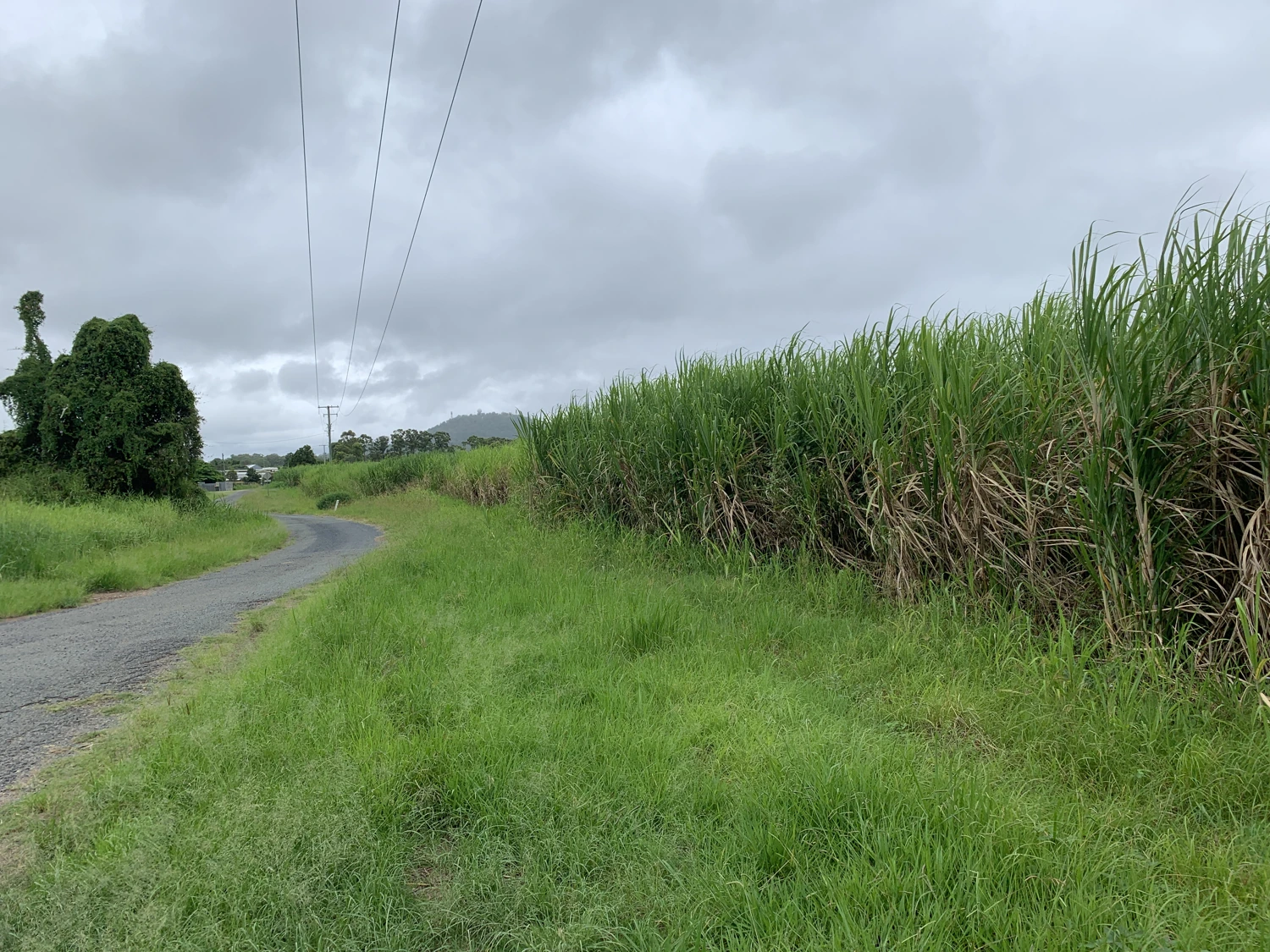
网页预览经过缩放或格式转换,未裁切;原比例尺与标签保留。 / Web preview resized or re-encoded without cropping; original scales and labels retained.
群体尺度实景:澳大利亚昆士兰Alberton的甘蔗田,沿Cane Farm Road向南拍摄。 照片用于观察田缘冠层与环境关系,未附带品种和产量测定资料。 摄影:Kerry Raymond,2022年1月26日,CC BY 4.0。
A crop-scale view of sugarcane in Alberton, Queensland, looking south along Cane Farm Road. The photograph shows the field-edge canopy and its surroundings; cultivar and yield measurements are unavailable. Photograph: Kerry Raymond, 26 January 2022, CC BY 4.0.
原图与许可 Original and licence 原始来源 Source | CC BY 4.0 | 原件未改动 Original unchanged
图001 02 甘蔗叶缘与表皮的真实显微图
Figure 001 02 Micrographs of sugarcane leaf margins and epidermis
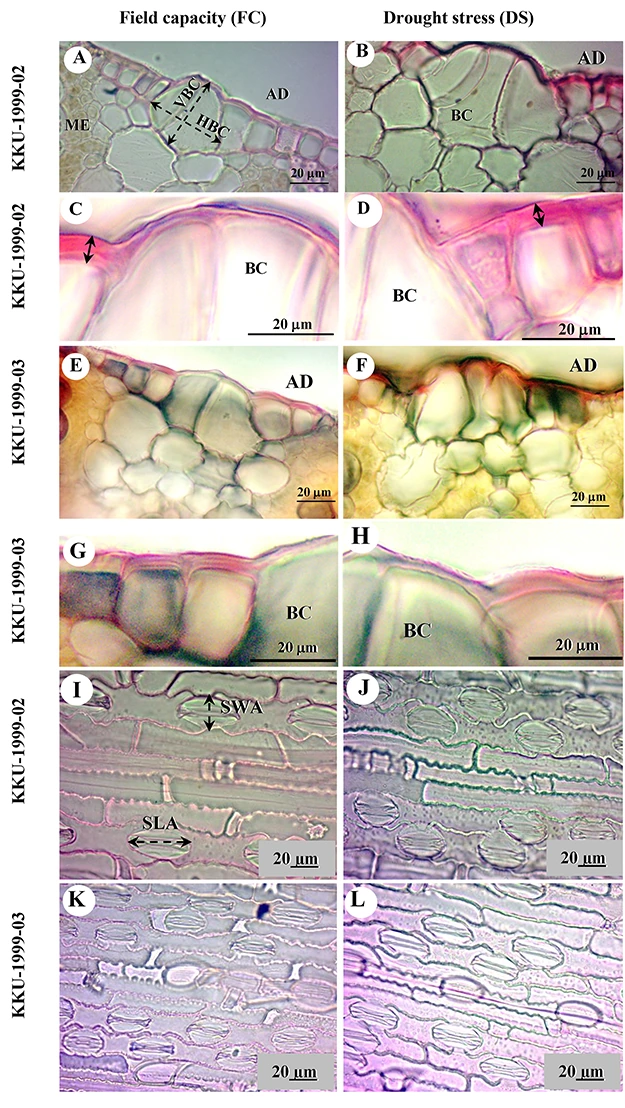
网页预览经过缩放或格式转换,未裁切;原比例尺与标签保留。 / Web preview resized or re-encoded without cropping; original scales and labels retained.
组织与细胞尺度:KKU-1999-02和KKU-1999-03的叶缘、表皮与气孔显微图;左列FC为正常供水对照,右列DS为干旱处理。 保留原图20微米比例尺及面板标记。 来源:Taratima等,2021,Figure 1,CC BY 4.0。
Tissue and cellular scales: leaf-margin, epidermal and stomatal micrographs of KKU-1999-02 and KKU-1999-03. FC identifies watered controls and DS drought treatment. Original 20 μm scale bars and panel labels are retained. Source: Taratima et al., 2021, Figure 1, CC BY 4.0.
原图与许可 Original and licence 原始来源 Source | CC BY 4.0 | 原件未改动 Original unchanged
标签释义:FC 供水对照;DS 缺水处理;AD 向轴面;BC 泡状细胞;VBC与HBC分别为垂直和水平尺寸;SWA与SLA为气孔宽、长标记。 ME未在所核图注中展开。 SWA/SLA的叶面归属在原文表述不一致,暂不判定。
Label key: FC, watered control; DS, drought treatment; AD, adaxial; BC, bulliform cell; VBC/HBC, vertical/horizontal dimensions; SWA/SLA, stomatal width/length markers. ME is not expanded in the inspected caption. Inconsistent surface assignment for SWA/SLA remains unresolved.
图001 03 甘蔗叶片与中脉横切面显微图
Figure 001 03 Micrographs of sugarcane leaf-blade and midrib cross-sections
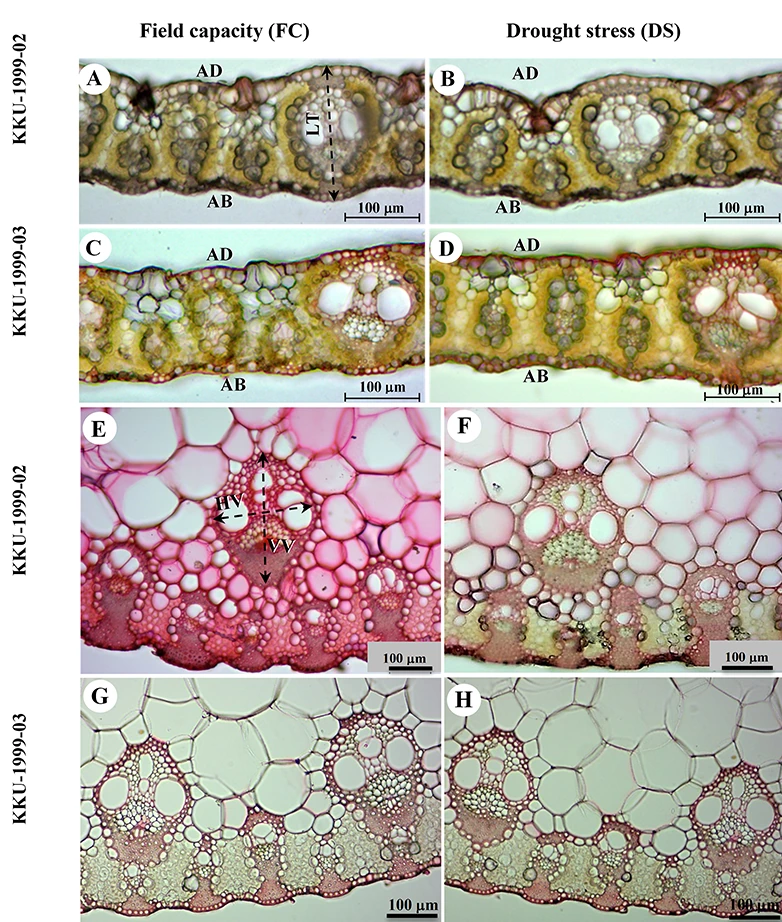
网页预览经过缩放或格式转换,未裁切;原比例尺与标签保留。 / Web preview resized or re-encoded without cropping; original scales and labels retained.
组织尺度:两个甘蔗品种在FC与DS处理下的叶片和中脉横切面。 A—D展示叶片组织,E—H展示中脉维管束区域;保留原图100微米比例尺。 结构观察需与独立生理测量配合解释。 来源:Taratima等,2021,Figure 2,CC BY 4.0。
Tissue scale: leaf-blade and midrib cross-sections from two sugarcane cultivars under FC and DS treatments. Panels A–D show blade tissues and E–H midrib vascular regions; original 100 μm scale bars are retained. Structural observations require complementary physiological measurements. Source: Taratima et al., 2021, Figure 2, CC BY 4.0.
原图与许可 Original and licence 原始来源 Source | CC BY 4.0 | 原件未改动 Original unchanged
标签释义:FC 供水对照;DS 缺水处理;AD 向轴面;AB 背轴面;LT 叶片厚度;VV与HV为大型维管束的垂直和水平尺寸。 图001 02与图001 03来自同一研究。 [S10]
Label key: FC, watered control; DS, drought treatment; AD/AB, adaxial/abaxial surfaces; LT, leaf thickness; VV/HV, vertical/horizontal size of a major vascular bundle. Figures 001 02 and 001 03 are from the same study.[S10]
001 08 适用边界与研究缺口
Applicability and research gaps
16 全书持续使用的判断规则
16 Rules carried through the encyclopedia
后续各章采用同一组判断:结论针对什么材料和环境;观测位于什么尺度与时间;测量的是状态、速率还是总量;处理单位是否与统计重复一致;机制解释是否超出证据;能否被独立研究检查。 把这些问题写清楚,章节之间才可以比较和累积。
Later chapters use the same checks: what material and environment the conclusion concerns; the scale and timing of observation; whether a state, rate or amount was measured; whether treatment units match statistical replication; whether mechanism exceeds evidence; and whether an independent study could check the result. These questions make cumulative comparison possible.
当前证据覆盖若干品种及中国、南非、阿根廷、巴西、留尼汪和泰国的具体研究,并附澳大利亚田间照片;这不是世界蔗区的代表性抽样。 热带与亚热带、雨养与灌溉、新植与多代宿根、不同遗传背景以及复合胁迫之间的比较,仍须在相应章节逐项补充。
The present selection covers particular studies in China, South Africa, Argentina, Brazil, Réunion and Thailand, plus an Australian field photograph. It is not a representative sample of global cane environments. Tropical versus subtropical systems, rainfed versus irrigated crops, plant cane versus later ratoons, genetic backgrounds and combined stresses require further evidence in the relevant chapters.
本章的直接产出是一个可执行的问题体系,而不是一个固定的高产公式。 后续研究应让每一个机制连接都有相应观测:从结构到功能,从器官到群体,从短期响应到完整生育期,再从单一条件到适用范围。
The chapter provides an operational system of questions, not a fixed high-yield formula. Subsequent work should attach appropriate observations to each mechanistic link: structure to function, organ to crop, short-term response to the full cycle, and one tested condition to a defined domain of applicability.
第002章《栽培甘蔗及近缘材料的生理多样性》承接本章的材料身份要求,进一步整理不同材料的可比性与证据边界。
Chapter 002, Physiological Diversity of Cultivated Sugarcane and Related Material, develops the material-identity requirements into comparisons among genetic materials and their evidence limits. Writing proceeds from 001 to 180.
附录A 双语术语
Appendix A Bilingual glossary
术语 Term | 本章用法 Usage in this chapter |
|---|---|
生理生态学 Ecophysiology | 把功能过程置于发育、环境和资源关系中研究。 Study of physiological function in developmental, environmental and resource contexts. |
基因型 Genotype | 用于标识遗传材料的单位;不替代具体样品编号。 Genetic-material identity, distinct from a physical sample identifier. |
分株 Ramet | 无性繁殖形成的植株单位;记录所用定义。 A vegetatively produced plant unit, with the counting convention specified. |
蔗蔸 Stool | 共同着生和管理的芽、茎及根系单元。 An associated bud, shoot and root unit used in management and observation. |
分蘖 Tiller | 由基部芽形成的侧生茎;出现、存活与收获归类分别记录。 A basal lateral shoot whose appearance, survival and harvest classification are recorded separately. |
新植蔗 Plant cane | 本次种植建立的作物周期。 The crop cycle established by planting. |
宿根蔗 Ratoon cane | 收获后由保留地下与基部组织再生的作物周期。 A regrowth crop from retained basal and belowground tissues after harvest. |
源与库 Source and sink | 定义时间与边界下的净同化物输出与输入功能。 Net assimilate export and import functions within a defined interval and boundary. |
物候 Phenology | 发育事件的出现时间及其关系。 The timing and relationships of developmental events. |
可塑性 Plasticity | 同一基因型在不同条件下形成不同性状表现的能力。 The capacity of the same genotype to express different phenotypes under different conditions. |
驯化 Acclimation | 同一生命过程中随环境经历形成的持续调整。 Sustained adjustment to environmental experience within a lifetime. |
昼夜变化 Diel variation | 自然或规定昼夜条件下观察到的时间变化。 Temporal variation observed under natural or imposed day–night conditions. |
内源昼夜节律 Circadian rhythm | 需相应实验支持的内源近24小时振荡。 An endogenous approximately 24-hour oscillation requiring appropriate experimental support. |
实验单位 Experimental unit | 可独立接受处理分配的单位。 A unit to which treatment can be assigned independently. |
亚样本 Subsample | 从同一实验单位内部取得的样品。 A sample taken within the same experimental unit. |
技术重复 Technical replicate | 对同一生物样品重复开展的测量或检测。 Repeated measurement or assay of the same biological sample. |
源库指标 Source–sink index | 按指定公式计算的代理指标,保留其定义。 A proxy computed by an explicit formula whose definition is retained. |
外推 Extrapolation | 将结论扩展至未直接研究的条件或尺度。 Extension of a conclusion beyond directly studied conditions or scales. |
可回收糖 Recoverable sugar | 依测量或规定计算程序确定的加工相关糖指标。 A processing-related sugar measure defined by measurement or a specified calculation. |
证据独立性 Evidence independence | 不同支持是否来自互不重复的观测与研究链。 Whether supporting observations and research chains are independent rather than reused. |
附录B 数据摘录与读取边界
Appendix B Extracted data and interpretation limits
配套JSON保存18条数值记录:14条试验设计或数据库登记记录,以及4条已发表汇总测量值。 每条记录有来源编号、变量、单位、定位和数据性质。 下表展示后者,便于检查“均值”“标准误”和“处理单位”的区别。
The companion JSON contains 18 numerical records: 14 design or repository-metadata records and four published summary measurements. Each has source, variable, units, locator and data class. The table below illustrates the distinction among means, standard errors and treatment units.
周龄 Age | CO₂处理 Treatment | 气孔导度均值 Mean gₛ | 标准误 SE |
|---|---|---|---|
6 | 环境 Ambient | 0.22 | 0.01 |
6 | 升高 Elevated | 0.13 | 0.005 |
50 | 环境 Ambient | 0.20 | 0.005 |
50 | 升高 Elevated | 0.13 | 0.007 |
单位均按原表记录为mol m⁻² s⁻¹。 来源为de Souza等2008年论文表1,材料SP80-3280、叶+1;环境与升高CO₂约为370和720 ppm。 作者报告至少10个重复/读数,但每处理只有两个气室,不能把植株读数当作独立气室重复。 正文与表注所写测量时段有差别,数据记录保留该疑点。 [S07]
Units follow the original table: mol m⁻² s⁻¹. Source: Table 1 of de Souza et al. 2008, SP80-3280 leaf +1, approximately 370 and 720 ppm CO₂. The authors report at least ten replicates/readings but two chambers per treatment; plant readings are not independent chambers. A discrepancy between methods and caption measurement times is retained.[S07]
这些数值是发表汇总值的直接转录,不是本百科测得的新数据,也不是重建的逐株观测。 本章不重新计算处理显著性或全球响应百分比。 完整的18条记录、来源关系及缺失项见配套证据与数据文件。
These values are transcribed published summaries, not new measurements or reconstructed individual observations. This chapter does not recalculate treatment significance or global response percentages. The companion evidence file retains all 18 records, source relationships and missing-data notes.
图像取得情况:3幅真实摄影/显微图版、1幅另存的数据图。 1幅排水器候选图在一次下载失败后停止,保留缺口且不计入取得数量。 GSE129543登记已核读,阵列数据未下载或重分析。
Media status: three authentic photographic/microscopy assets and one separately retained graph. A candidate hydathode figure was stopped after one failed download and is excluded from acquired counts. GSE129543 metadata were inspected; array data were not downloaded or reanalysed.
附录C 原始来源与图像署名
Appendix C Original sources and image credits
本章使用9篇原始研究、1个关联官方数据集登记和1个原作者照片来源。 Dantas两篇论文存在部分数据复用;显微图1与图2来自同一研究。 以下编号与正文及JSON一致。
The chapter uses nine original papers, one associated official dataset record and one creator-deposited photograph. The Dantas papers partly reuse data; both microscopy plates come from one study. Identifiers match the text and JSON.
[S01] A. J. McCormick, M. D. Cramer, D. A. Watt (2006). Sink strength regulates photosynthesis in sugarcane.
库强度对甘蔗光合作用的调节
New Phytologist 171 759–770 DOI 10.1111/j.1469-8137.2006.01785.x
[S02] Julio V. Saez, Jorge A. Mariotti, Claudia R. C. Vega (2019). Source–sink relationships during early crop development influence earliness of sugar accumulation in sugarcane.
早期作物发育中的源库关系与甘蔗积糖早熟性
Journal of Experimental Botany 70 19 5157–5171 DOI 10.1093/jxb/erz251 | 机构全文 Institutional full text
[S03] Fernanda C. C. Marcos, Neidiquele M. Silveira, Paulo E. R. Marchiori et al. (2018). Drought tolerance of sugarcane propagules is improved when origin material faces water deficit.
供种母株缺水经历与甘蔗繁殖材料后续抗旱表现
PLOS ONE 13 12 e0206716 DOI 10.1371/journal.pone.0206716
[S04] Rongfa Chen, Yegeng Fan, Haifeng Yan et al. (2020). Enhanced Activity of Genes Associated With Photosynthesis, Phytohormone Metabolism and Cell Wall Synthesis Is Involved in Gibberellin-Mediated Sugarcane Internode Growth.
赤霉素介导的甘蔗节间生长及光合 激素和细胞壁相关基因活动
Frontiers in Genetics 11 570094 DOI 10.3389/fgene.2020.570094
[S05] Luíza Lane de Barros Dantas, Felipe Marcelo Almeida-Jesus, Natalia Oliveira de Lima et al. (2020). Rhythms of Transcription in Field-Grown Sugarcane Are Highly Organ Specific.
田间甘蔗转录节律的器官特异性
Scientific Reports 10 6565 DOI 10.1038/s41598-020-63440-7
[S06] Luíza Lane Barros Dantas, Maíra Marins Dourado, Natalia Oliveira de Lima et al. (2021). Field microenvironments regulate crop diel transcript and metabolite rhythms.
田间微环境与作物昼夜转录及代谢节律
New Phytologist 232 4 1738–1749 DOI 10.1111/nph.17650
[S07] Amanda Pereira de Souza, Marilia Gaspar, Emerson Alves da Silva et al. (2008). Elevated CO2 increases photosynthesis, biomass and productivity, and modifies gene expression in sugarcane.
升高二氧化碳条件下甘蔗光合、生长及基因表达的变化
Plant, Cell & Environment 31 8 1116–1127 DOI 10.1111/j.1365-3040.2008.01822.x
[S08] Susie Guilly, Thomas Dumont, Audrey Thong-Chane et al. (2017). Analysis of multienvironment trials (MET) in the sugarcane breeding program of Réunion Island.
留尼汪岛甘蔗育种多环境试验分析
Euphytica 213 213 DOI 10.1007/s10681-017-1994-1
[S09] Dantas LB, de Lima ON, Nishiyama YM Jr et al. (2019). Vast differences in organ-specific rhythms of transcription in field-grown sugarcane.
田间甘蔗器官特异转录节律数据集
NCBI Gene Expression Omnibus GSE129543
[S10] Worasitikulya Taratima, Thapakorn Ritmaha, Nakorn Jongrungklang et al. (2021). Leaf Anatomical Adaptation Under Early Drought Stress of Sugarcane Cultivars – KKU-1999-02 and KKU-1999-03.
KKU甘蔗材料早期缺水处理下的叶片解剖研究
Acta Agrobotanica 74 7419 DOI 10.5586/aa.7419 | CC BY 4.0
[S11] Kerry Raymond (2022). Sugarcane fields looking south along Cane Farm Road Alberton.
Alberton甘蔗田实景照片
Creator-deposited photograph / 原作者照片 原始来源 Source | CC BY 4.0
影像署名:图001 01为Kerry Raymond原作,2022年1月26日为作者记录日期;图001 02与03为Taratima等2021年原始研究图1与图2。 三幅均采用CC BY 4.0,原件未修改,仅在文档中等比例排版。 另存Chen等2020年图1为发表数据图,许可为原文所示CC BY。
Image credits: Figure 001 01 is by Kerry Raymond, with source-reported capture date 26 January 2022; Figures 001 02 and 03 are Figures 1 and 2 of Taratima et al. 2021. All three use CC BY 4.0. Originals are unchanged and proportionally scaled in the document. The separately retained Chen et al. 2020 Figure 1 is a published graph licensed CC BY as stated by the source.
版本说明:本章为可审阅的双语初稿。 原始研究的核读、个别主张核验、图像取得和原始数据重分析分别记录;本章未进行新田间试验,也未取得所有研究的逐株原始数据。
Version note: this is a reviewable bilingual draft. Reading original research, verifying individual claims, acquiring media and reanalysing raw data are tracked separately. No new field experiment was conducted, and individual-level raw data were not obtained for every study.