01
扶蔗与刀台分别仿形Separate lifter and header following
左右扶蔗器拟独立随地形浮动,割台采用独立限深与整体升降。The lifters are intended to follow terrain separately; the header has its own depth reference and vertical movement.
GAKI DESIGN ARCHIVE · 2026-09-21
GAKI Automatic Terrain-Following Billet Sugarcane Harvester
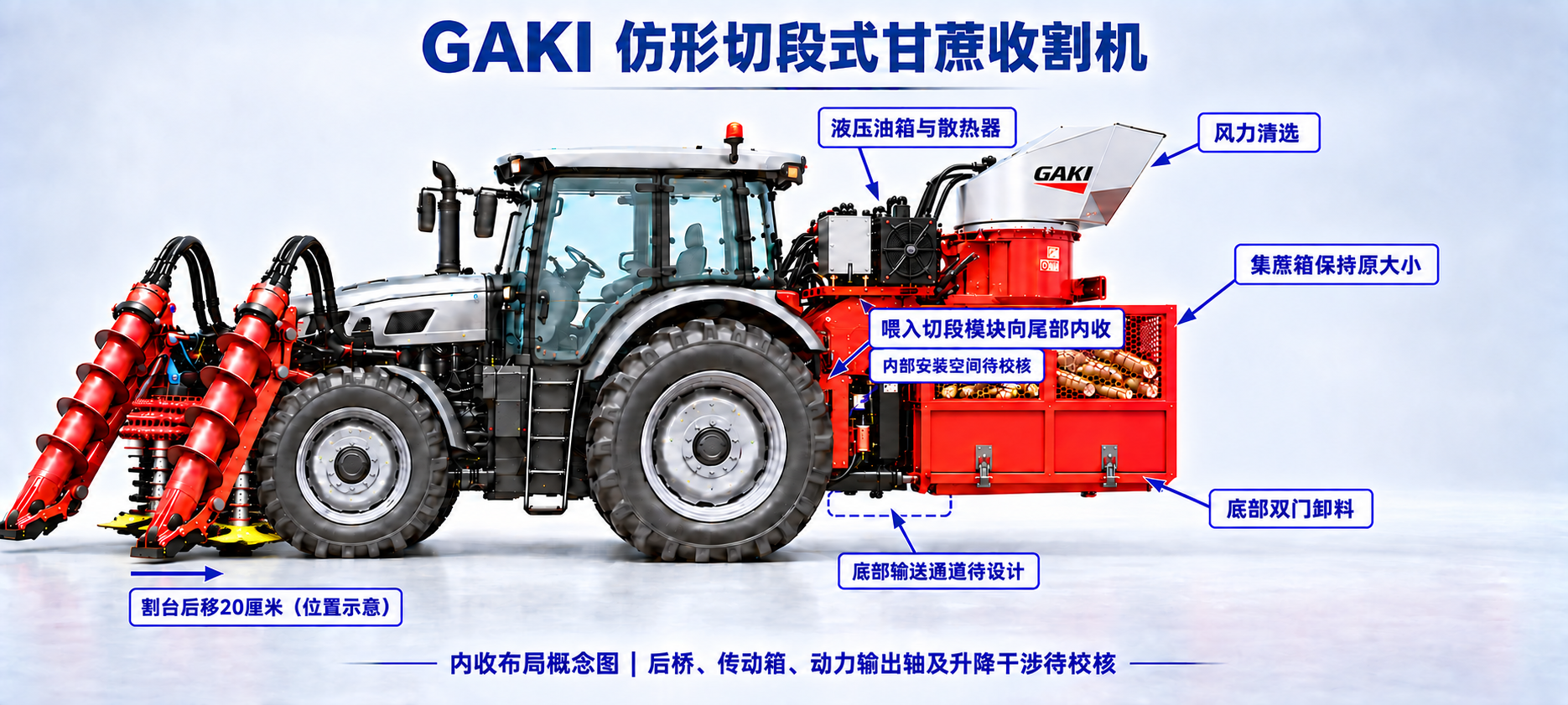
拖拉机可拆卸配挂式设计:前置双螺旋扶蔗与仿形割台,结合后部紧凑切段、风力清选和底门集料箱。A detachable tractor-mounted concept combining front spiral crop lifters and a terrain-following header with compact rear chopping, air cleaning and a bottom-discharge collector.
GAKI · AI辅助设计效果图 / AI-assisted design illustration
本页记录最新切段式布局及拟定工作原理:割台按后移20厘米的目标调整,尾部喂入切段模块进一步内收。以简单、耐用、可拆卸为设计方向;底部贯通输送、自动控制、动力与承载仍需工程验证。This page documents the latest billet-harvester layout and proposed principles: a target 20 cm rearward header shift and a more deeply nested rear feed/chopper module. Simplicity, durability and detachability guide the concept. Underbody transfer, automatic control, power and load capacity require engineering validation.
左右扶蔗器拟独立随地形浮动,割台采用独立限深与整体升降。The lifters are intended to follow terrain separately; the header has its own depth reference and vertical movement.
喂入、切段与清选集中在后部,液压油箱和散热器随模块布置。Rear feeding, chopping and cleaning are grouped with the hydraulic tank and oil cooler.
以100公斤蔗段为集料目标,纵向安装,底部双门向下卸料。A longitudinal collector targets 100 kg of billets and uses two downward-opening floor doors.
GAKI自动仿形甘蔗切段式收割机,是以拖拉机为动力与行走平台的可拆卸配挂式设计方案。前部完成扶蔗、姿态调整、根部切割及初步剥叶;拟经车底纵向通道向后喂送,在尾部完成切段、风力清选、集料和底门卸料。整机以结构简洁、耐用、便于维修和控制成本为设计目标。The GAKI automatic terrain-following billet sugarcane harvester is a detachable implement concept using a tractor for propulsion and power. Front equipment lifts and guides cane, cuts stalks at the base and begins leaf stripping. A proposed longitudinal underbody passage would feed a rear module for chopping, air cleaning, collection and bottom discharge. Simplicity, durability, serviceability and controlled cost are design priorities.
本方案延续设计者自述的2005年甘蔗收割机试制经历。早期试机暴露出30匹马力拖拉机动力不足、动力输出轴驱动油泵与前进速度匹配不佳的问题。因此,本轮设计把喂入连续性、液压功率分配和低速作业匹配列为重点。早期经历是研发背景,不构成本次新布局的试验验证。The concept builds on the designer’s account of prototype work beginning in 2005. Early trials reportedly exposed insufficient power from a 30-hp tractor and poor matching between a PTO-driven hydraulic pump and travel speed. Continuous feeding, hydraulic power allocation and low-speed operation are therefore central to this revision. Those earlier experiences do not validate the new arrangement.
前方采用左右对称的螺旋扶蔗器。每侧顶部设置一个液压旋转马达;另设升降油缸负责高度调整。按已确认的连接形式,每侧保留第一、第三根承载支臂,取消中间第二根刚性支架。基架安装位置靠近拖拉机承载大梁、位于前轮内侧。Two symmetric spiral crop lifters are placed ahead of the tractor. Each has one hydraulic rotary motor at the top and a separate lift cylinder for height adjustment. The agreed linkage retains the first and third load-carrying arms on each side and removes the middle rigid arm. Base brackets are positioned close to the tractor’s structural rails, inside the front wheels.
拟采用接地滑靴或限深轮感知局部起伏,以卸荷机构减轻接地压力,配合允许受控随动的液压回路,使左右扶蔗器分别跟随地面。旋转螺旋叶片不作为触地探头。低位齿状推蔗辊负责调整蔗秆姿态,其安装不能将左右仿形机构刚性锁成一个整体。Ground-contact skids or gauge wheels are proposed to reference local terrain. A weight-relief arrangement and a controlled floating hydraulic circuit would allow the lifters to follow the ground separately. Rotating spiral flights are not ground probes. The low toothed knockdown roller guides stalk posture; its supports must not rigidly lock the two independently moving lifters together.
割台采用封闭齿轮箱、竖向剥叶轴与底部刀盘组成的总成,两侧通过对称双支臂连接拖拉机基架。基础仿形方式为割台整体上下浮动,并在接近刀盘切割区域的位置设置独立限深基准。刀片承担切割,不承担支撑或探地功能。The header combines an enclosed gearbox, vertical stripping shafts and basal cutting discs. Symmetric upper and lower support arms connect it to the tractor frame. The basic terrain-following arrangement moves the complete header vertically, using a separate depth reference near the cutting zone. Blades perform cutting; they are not supports or ground probes.
本次最新效果图按割台向拖拉机方向后移20厘米的目标调整,扶蔗器、推蔗辊及后部装置沿用已确认的位置关系。20厘米为设计目标,尚不是已测量的制造尺寸;后续需在SolidWorks装配中锁定,并检查轮胎转向、前桥摆动、刀片扫掠及全升降行程。The latest illustration represents a target rearward header shift of 20 cm toward the tractor, retaining the agreed placement of the lifters, knockdown roller and rear equipment. This is a design target rather than a measured manufacturing dimension. It must be set in a dimensioned SolidWorks assembly and checked against steering, front-axle articulation, blade sweep and the full lift travel.
双支臂与封闭箱体本身不等于已经实现全方向仿形。基础方案主要处理纵向地面起伏;如需适应左右高低差,应另设经校核的横向随形自由度。割台浮动过程中应保持齿轮啮合、轴间距和必要的刀盘相位关系。Paired support arms and an enclosed gearbox do not by themselves provide terrain following in every direction. The basic concept primarily addresses longitudinal ground variation. Lateral following requires an additional, verified degree of freedom. Gear mesh, shaft spacing and any required cutter phasing must remain controlled throughout header motion.
自动控制拟以刀盘附近的探地位移为主要输入,结合油缸位置、液压压力及必要的机身姿态信号,比较实际切割高度与设定值,通过比例阀修正升降。设置滤波、死区、速度限制和行程限制,避免对细碎土块反复追随。压力用于辅助判断负载和异常,不能直接等同于地面高度。The proposed control uses ground-reference displacement near the cutter as its main input, supported by cylinder position, hydraulic pressure and, where necessary, tractor attitude. A controller would compare cutting height with a setpoint and command a proportional valve. Filtering, a deadband, rate limits and travel limits would reduce unnecessary response to small disturbances. Pressure helps identify loads and abnormal events; it is not a direct ground-height measurement.
调位、仿形、抬升和运输锁止应分别定义。作业时既要允许随地形运动,又要控制机构下沉和冲击;运输时采用可靠承载保持与机械锁止。本页的“自动仿形”描述研发目标和拟用原理,不表示传感器、阀组、控制程序或田间性能已经验证。它也不表示无人驾驶。Height setting, terrain following, lifting and transport locking require distinct operating states. Field operation must permit following motion while controlling descent and impact; transport requires load holding and mechanical locking. “Automatic terrain following” here describes the development objective and proposed principle, not validated sensors, valves, software or field performance. It does not mean autonomous driving.
拟定的单次通过流程为:拾扶倒伏蔗 → 齿状推蔗辊调整姿态 → 根部切断 → 夹持并提升蔗根端 → 槽纹胶辊向后输送并配合剥叶 → 尾部连续喂入。剥叶部件采用可更换的黑色柔性耐磨件,其材料方向沿用设计者提出的轮胎材料方案;具体胶料、帘线外露风险、柔顺性和伤蔗情况仍需选材试验。The intended single-pass sequence is lodged-cane lifting, posture adjustment by the toothed roller, basal cutting, positive gripping and butt lifting, rearward transfer by grooved rubber rollers with further stripping, and continuous rear-module feeding. Replaceable black flexible wear elements follow the designer’s tyre-material concept. Compound selection, exposed reinforcement, compliance and stalk damage require material tests.
输送与剥叶应分清作用:胶辊提供夹持牵引,柔性件通过相对运动脱除蔗叶。提升动作需有明确的上行牵引或导向机构,不能仅凭竖轴剥叶辊的外观认定已实现规定提升高度。滚轮间隙、浮动压紧量和牵引速度,需要结合湿蔗、粗细差异和多根并列喂入验证。Transfer and stripping have distinct roles: rubber rollers provide grip and traction, while flexible elements remove leaves through relative motion. Lifting needs a defined upward driving or guiding mechanism; a vertical stripping rotor alone does not demonstrate a specified lift height. Roller gap, compliant clamping travel and feed speed require tests with wet stalks, varying diameters and multiple stalks fed together.
拖拉机底部贯通输送通道仍是本方案尚未解决的关键接口。必须实测发动机、前后桥、传动轴、转向机构和最小离地间隙后才能定型;已取消遮挡轮胎外侧的输送机构。效果图中的空间遮挡不代表甘蔗已经能够穿过这些部位。The continuous underbody passage remains a critical unresolved interface. Its geometry must follow measurements of the engine, axles, driveline, steering and minimum ground clearance. The previously rejected outside-wheel conveyor is excluded. Visual occlusion in the illustration does not establish a usable crop passage.
尾部喂入与切段模块采用紧凑内收的布局构想,油箱、散热器及配套安装架集中在模块上。槽纹胶辊连续夹持甘蔗进入封闭切段器;蔗段随后进入清选空间,轻质蔗叶随气流排出,蔗段向下落入集料箱。切段长度由有效喂入速度与实际切割事件频率共同决定,风量需兼顾含杂率与蔗段损失。The rear feed-and-chopper module uses a compact nested packaging concept, with the hydraulic tank, cooler and their supports grouped on the module. Grooved rubber rollers would feed an enclosed chopper continuously. Billets then enter an air-cleaning zone, where light trash follows the exhaust flow and billets fall into the collector. Billet length depends on effective feed speed and actual cutting-event frequency; airflow must balance cleaning against cane loss.
集蔗箱沿拖拉机纵向布置,以收集约100公斤蔗段为目标。底部左右两扇门向下开启卸料,后壁保持固定;箱体容积、门轴、锁止件及卸料油缸均需计算。此切段式短箱与原整杆式2米收缩、3.5米展开、空箱竖立折叠的长箱是不同配置,不能直接共用其折叠结论。The collection bin is aligned with the tractor’s longitudinal axis and targets approximately 100 kg of billets. Two floor doors open downward, while the rear wall stays fixed. Bin volume, door pivots, latches and discharge actuators require calculation. This short billet bin is a different configuration from the earlier whole-stalk box that retracts to 2 m, extends to 3.5 m and folds upright when empty; that folding concept is not automatically transferred to this design.
内收的目的在于减小后悬伸出长度,但把部件在侧视图中藏到轮胎后面,并不证明后桥、传动箱和动力输出轴之间存在可用空间。实际设计必须保留升降、检修、散热及油管运动余量,并计算整机重心和前后桥载荷。Nesting the module aims to reduce rear overhang. Hiding components behind a tyre in side view does not prove that space is available around the axle, transmission or PTO. The physical design must retain lift, service, cooling and hose-motion clearance and account for the machine’s centre of gravity and axle loads.
拟由拖拉机动力输出轴经适配驱动带动液压泵,分配到扶蔗、割台、输送、切段、风机及升降卸料回路。泵的允许转速、传动比、支承和扭矩反力需按具体型号设计,不能假定任意油泵可直接悬挂在动力输出轴上。回路应包含匹配的过载保护、过滤、温度监测、冷却与维护接口。A compatible PTO drive is proposed for the hydraulic pump, supplying crop lifting, cutting, transfer, chopping, extraction, lifting and discharge functions. Pump speed limits, drive ratio, supports and torque reaction must be designed for the selected equipment; an arbitrary pump cannot be assumed suitable for direct unsupported PTO mounting. Circuit design should include appropriate overload protection, filtration, temperature monitoring, cooling and service access.
30—60匹马力是适配研究范围,尚非整机保证。切段器与风机增加了功率和散热需求,应把可用PTO功率、行走需求、泵马达效率及冲击负载一起核算。装置拟通过承载副车架、销轴和液压快接拆装,拆卸后拖拉机恢复其他农事用途;具体车型的挂点承载与驻放支撑需要另行设计。The 30–60 hp range is an integration study target, not a machine rating or compatibility guarantee. The chopper and fan add power and cooling demand. Available PTO power, propulsion demand, pump/motor efficiency and transient loads must be assessed together. A load-bearing subframe, pins and hydraulic couplings are proposed for removal and refitting so the tractor can return to other work. Mount capacity and detached-module supports require tractor-specific design.
按设计者给定的20根可收割蔗秆/米行长,若根部切割平均能力目标为5根/秒,则理论平均前进速度为5÷20=0.25米/秒,即0.9公里/小时。输送与剥叶10根/秒是下游能力目标,不代表整机已能以10根/秒收获。蔗丛瞬时密度、倒伏程度和堵塞都会影响可用速度。Using the designer’s assumption of 20 harvestable stalks per metre of row and a target mean basal-cutting rate of 5 stalks/s gives an ideal mean travel speed of 5/20 = 0.25 m/s, or 0.9 km/h. The downstream target of 10 stalks/s for transfer and stripping is not a demonstrated whole-machine harvest rate. Local stool density, lodging and blockages affect usable speed.
后续应先完成实车测绘及贯通输送路径,再做三维装配干涉、机构自由度、满载受力、液压热平衡与控制响应计算。台架和田间试验需记录留茬高度偏差、刀片触土、宿根损伤、伤蔗率、含杂率、蔗段损失、堵塞次数、油温和实际功率,依据结果修订设计。Next steps are tractor measurement and a feasible continuous crop path, followed by CAD interference checks, linkage mobility, loaded structural assessment, hydraulic heat balance and control-response analysis. Bench and field tests should record stubble-height error, blade-soil contact, stool damage, stalk damage, trash content, billet loss, blockages, oil temperature and actual power, then feed the results back into the design.
| 项目 / Item | 目标 / Target | 状态 / Status |
|---|---|---|
动力平台Power platform | 30—60匹马力拖拉机30–60 hp tractor | 适配研究范围,待功率与承载核算Integration target; power and load checks pending |
割台位置Header position | 向后移动20厘米20 cm rearward shift | 相对前一版的调整目标Target adjustment relative to the preceding layout |
原料长度Incoming stalk length | 约3米及以上的整根甘蔗Approximately 3 m or longer | 夹持、转向与输送需试验Grip and transfer need testing |
切割流量Basal cutting rate | 平均5根/秒Mean 5 stalks/s | 研发目标,未测定Development target; not measured |
输送与剥叶Transfer and stripping | 10根/秒10 stalks/s | 下游能力目标,非整机产能Downstream target, not whole-machine capacity |
集蔗载荷Collected crop | 约100公斤蔗段Approximately 100 kg of billets | 不含装置自重;容积待核算Excludes implement mass; volume check pending |
卸料方式Unloading | 底部左右双门向下开启Two downward-opening floor doors | 门轴、锁止和驱动待设计Pivots, latches and actuation to be designed |
贯通输送Continuous transfer | 拖拉机底部纵向布置Proposed longitudinal underbody route | 通道尚未定型,属关键待解决项Unresolved critical interface |
John Deere CH570官方产品手册(2015年2月修订)John Deere CH570 official brochure (revised February 2015)
原理参考范围:第7—8页的喂入、切段与清选关系,以及第13页的浮动分蔗器和位置/压力辅助割台控制。大型商业机型的参数与效果不能用于证明GAKI方案。Principle reference: feeding, chopping and cleaning on pages 7–8, and floating crop dividers with position/pressure-assisted header control on page 13. The large commercial machine’s specifications do not validate the GAKI concept.
点击放大 / Select an image to enlarge
放大 / Enlarge ↗按本轮位置调整要求制作的概念效果图。割台后移20厘米为目标;刀盘与轮胎间隙、尾部安装空间及输送路径需实测建模。Concept illustration of the requested position changes. The 20 cm header shift is a target; cutter-to-tyre clearance, rear installation space and crop transfer require measurement and modelling.